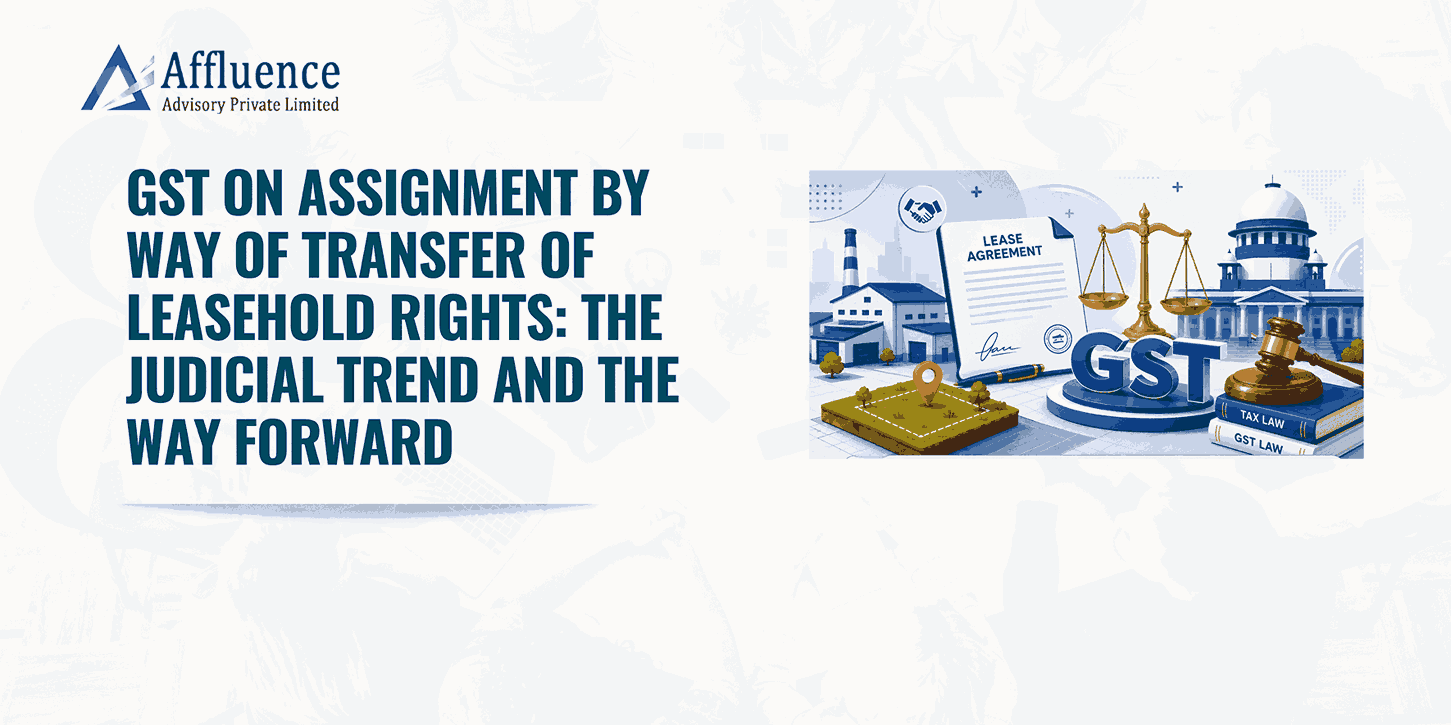
The levy of GST on assignment by way of transfer of leasehold rights of industrial plots allotted by bodies such as MIDC and GIDC has been a deeply contested issue. Revenue authorities have consistently treated such transactions as a taxable supply of services at 18%, relying on Section 7(1)(a) of the CGST Act read with Schedule II, Clause 5(b) (renting of immovable property = supply of service). Taxpayers, on the other hand, have contended that a complete assignment, wherein the assignor’s rights are extinguished and the assignee steps in as the new lessee constitutes a transfer of benefits arising out of immovable property, excluded from GST under Schedule III.
The Hon’ble Gujarat High Court on 3rd January 2025 in Gujarat Chamber of Commerce and Industry and Others vs. Union of India [TS-03-HC(GUJ)-2025-GST], concerning assignment of leasehold rights in GIDC plots. The Court held:
“Assignment by sale and transfer of leasehold rights of the plot of land allotted by GIDC to the lessee in favour of third party-assignee for a consideration shall be assignment/sale/transfer of benefits arising out of ‘immovable property’… provisions of Section 7(1)(a) of the GST Act read with Clause 5(b) of Schedule II and Clause 5 of Schedule III would not be applicable to such transaction… and same would not be subject to levy of GST as provided under Section 9 of the GST Act.”
Following the Gujarat HC ruling, the Bombay High Court delivered multiple judgments in the same direction. In Aerocom Cushions Pvt. Ltd. vs. Assistant Commissioner (Anti Evasion) [9th January 2026], the Nagpur Bench quashed a ₹27 lakh GST demand against a petitioner who had assigned its 95-year MIDC leasehold rights, holding that the transaction had no nexus with business activity and was purely a transfer of immovable property.
The Hon’ble Supreme Court, in its order dated 22nd May 2026, dismissed the SLP filed by the GST department challenging the Aerocom Cushions judgment. While a dismissal of an SLP is not a declaration of law and does not mean the Supreme Court has affirmed every proposition in the Bombay High Court’s judgment, it nevertheless reflects the Supreme Court’s disinclination to interfere with the well-reasoned view of the High Courts, sending a strong signal about the emerging judicial consensus on this issue.
Separately, the principle bench of the Hon’ble Bombay High Court in the case of Swastik Processor v. Union of India [Writ Petition (L) No. 42522 of 2025] had granted interim relief to the taxpayers and recorded that the revenue has assailed the decision of Hon’ble Gujarat High Court in the case of Gujarat Chamber of Commerce and Industry (supra) in the proceedings SLP(C) (D) No.33270 of 2025. The SLP(C) (D) No.33270 of 2025 is scheduled to be listed before the Supreme Court on 13.07.2026 and the decision in the said case would be highly awaited by the taxpayers of the country.
The Way Forward
Since the Hon’ble High Courts have already either passed a final order or an interim order in the matters, it is advisable to challenge the SCNs/orders directly at the High Court, in the wake of the Supreme Court’s inclination towards rejecting the SLP filed by the Revenue department. Taxpayers who have received SCNs or adjudication orders demanding GST on assignment of leasehold rights should seek appropriate legal advice at the earliest as the judicial tide is firmly in their favour, and the Supreme Court’s hearing on 13th July 2026 may provide the conclusive answer the industry has long awaited.
Disclaimer: This article provides general information existing at the time of preparation and we take no responsibility to update it with the subsequent changes in the law. The article is intended as a news update and Affluence Advisory neither assumes nor accepts any responsibility for any loss arising to any person acting or refraining from acting as a result of any material contained in this article. It is recommended that professional advice be taken based on specific facts and circumstances. This article does not substitute the need to refer to the original pronouncement.
CLICK HERE TO DOWNLOAD PDF