Introduction:
Independent Directors (IDs) occupy a unique position in the corporate governance framework. They act as guardians of minority shareholder interests, provide unbiased oversight to management, and contribute to balanced decision-making at the board level.
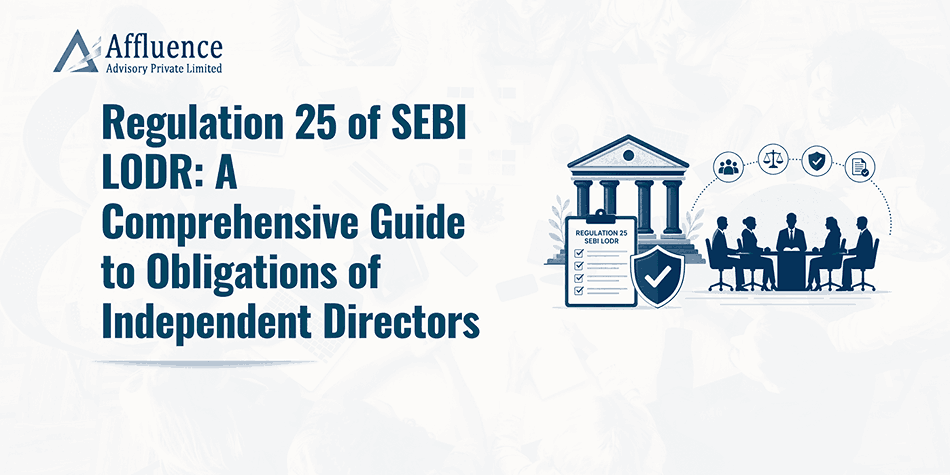
Recognising the significance of their role, the Securities and Exchange Board of India (SEBI) has prescribed specific obligations, responsibilities, appointment requirements, and safeguards for Independent Directors under Regulation 25 of the SEBI (Listing Obligations and Disclosure Requirements) Regulations, 2015 (“SEBI LODR”).
Over the years, Regulation 25 has undergone multiple amendments aimed at strengthening board independence, enhancing accountability, improving shareholder participation in appointment processes, and protecting Independent Directors from undue risks.
This article provides a detailed analysis of Regulation 25 as applicable currently.
Objective of Regulation 25:
The primary purpose of Regulation 25 is to:
- Strengthen board independence.
- Ensure effective oversight over management.
- Protect minority shareholders.
- Enhance transparency and accountability.
- Provide a framework for appointment, tenure, evaluation, liability, and protection of Independent Directors.
- Promote robust corporate governance practices in listed entities.
1. No Alternate Director for an Independent Director:
Regulation 25(1) prohibits appointment or continuation of any alternate director for an Independent Director.
Practical Impact
An Independent Director is appointed because of his or her specific expertise, objectivity, experience, and independent judgment.
Allowing an alternate director could dilute the very purpose of independence because:
- Independence is personal in nature.
- It cannot be delegated.
- The alternate director may not possess the same qualifications or independent mindset.
Therefore, if an Independent Director is unable to attend board meetings, the vacancy cannot be filled through an alternate director arrangement.
Governance Rationale
SEBI believes that board independence is attached to the individual and not merely to the office occupied.
2. Maximum Tenure of Independent Directors:
The tenure of Independent Directors is governed by the Companies Act, 2013 and rules framed thereunder.
Currently, under Section 149 of the Companies Act, 2013:
- An Independent Director can hold office for a term of up to 5 consecutive years.
- Re-appointment is permitted through a special resolution.
- Maximum tenure is two consecutive terms.
- Accordingly, an Independent Director can generally serve for a maximum period of 10 years.
- Thereafter, a cooling-off period of three years becomes applicable before reappointment.
Why Tenure Limits Matter
Long association with management may impair independence.
Tenure restrictions ensure:
- Fresh perspectives.
- Independent thinking.
- Reduced familiarity threats.
- Better governance standards.
3. Appointment, Re-Appointment and Removal Through Special Resolution:
One of the most significant governance reforms introduced by SEBI is the requirement that:
Appointment
Appointment of an Independent Director must be approved by shareholders through a Special Resolution.
Re-Appointment
Re-appointment after completion of tenure also requires a Special Resolution.
Removal
Removal of an Independent Director similarly requires shareholder approval.
Why Special Resolution?
A Special Resolution requires at least 75% votes in favour.
This higher threshold:
- Enhances shareholder participation.
- Prevents arbitrary appointments.
- Ensures wider acceptance of Independent Directors.
4. The “Dual Approval” Concept Introduced by SEBI:
SEBI recognised situations where a candidate enjoys substantial support from public shareholders but falls marginally short of the 75% threshold required for a Special Resolution.
Accordingly, a special mechanism was introduced.
Appointment Deemed Approved Even if Special Resolution Fails
An Independent Director shall be deemed appointed if:
Condition 1
- Votes in favour exceed votes against.
AND
Condition 2
- Public shareholder votes in favour exceed public shareholder votes against.
If both conditions are satisfied, the appointment is deemed approved despite failure of the Special Resolution.
Significance
This provision:
- Strengthens minority shareholder voice.
- Prevents concentration of power.
- Ensures public shareholders have meaningful participation in the appointment process.
5. Additional Protection in Case of Removal:
Where an Independent Director has been appointed under the above mechanism, removal becomes more stringent.
Removal is possible only if:
- Votes in favour of removal exceed votes against.
AND
- Public shareholder votes in favour of removal exceed public shareholder votes against.
Purpose
This provision protects Independent Directors from:
- Arbitrary removal.
- Promoter pressure.
- Retaliatory actions arising from independent decision-making.
6. Separate Meeting of Independent Directors:
Independent Directors must hold at least one exclusive meeting during every financial year.
Who Cannot Attend?
The following persons must remain absent:
- Non-independent directors.
- Executive directors.
- Members of management.
Attendance Expectation
All Independent Directors should strive to attend such meetings.
Importance of Separate Meetings
These meetings provide a platform to:
- Discuss governance concerns.
- Review board functioning.
- Share candid observations.
- Evaluate management objectively.
Such discussions can occur without influence from executive management.
7. Key Matters to be Reviewed in the Independent Directors’ Meeting:
The exclusive meeting of Independent Directors must, among other things, review the following:
(a) Performance of Non-Independent Directors and the Board
Independent Directors evaluate:
- Board effectiveness.
- Contribution of executive directors.
- Strategic oversight.
- Governance quality.
(b) Performance of the Chairperson
The chairperson’s leadership role is separately evaluated.
Factors generally considered include:
- Board leadership.
- Meeting effectiveness.
- Strategic guidance.
- Ability to encourage healthy board discussions.
Views of executive and non-executive directors may also be considered.
(c) Quality, Quantity and Timeliness of Information
Independent Directors assess whether information provided by management is:
- Accurate.
- Relevant.
- Sufficient.
- Timely.
Without quality information, effective board oversight becomes impossible.
8. Liability of Independent Directors:
One of the most important safeguards under SEBI LODR relates to the liability of Independent Directors.
An Independent Director shall be liable only when:
The act occurred with his/her knowledge
Knowledge must be attributable through board processes.
There is consent or connivance
The Independent Director knowingly approved or facilitated the wrongful act.
Failure to Act Diligently
The Independent Director failed to exercise reasonable care expected from a prudent director.
Practical Significance
Independent Directors are not liable merely because they sit on the board.
Their liability arises only when:
- They knew of the misconduct.
- They consented to it.
- They participated in it.
- They failed to exercise due diligence.
This provision balances accountability with protection.
9. Omission of Mandatory Replacement Requirement:
Earlier, listed entities were required to replace a resigned or removed Independent Director within a specified timeline.
This provision was omitted with effect from 12 December 2024.
Practical Impact
Now, replacement requirements are governed through broader board composition requirements and applicable provisions under:
- Companies Act, 2013.
- SEBI LODR board composition norms.
The omission provides greater flexibility while ensuring compliance with minimum board independence requirements.
10. Familiarisation Programme for Independent Directors:
Listed entities are required to familiarise Independent Directors regarding the company and its operations.
The programme should cover:
Industry Understanding
Nature and dynamics of the industry.
Business Model
Revenue generation mechanisms.
Roles and Responsibilities
Duties and expectations from Independent Directors.
Other Relevant Information
Any information necessary for effective discharge of responsibilities.
Importance
An informed Independent Director can:
- Ask better questions.
- Evaluate risks effectively.
- Participate meaningfully in board deliberations.
11. Annual Declaration of Independence:
Every Independent Director must submit a declaration:
At the First Board Meeting After Appointment
AND
At the First Board Meeting of Every Financial Year
AND
Whenever Circumstances Change
The declaration confirms that:
- The director satisfies independence criteria under Regulation 16.
- No circumstances exist that could impair independent judgment.
Objective
Independence is not a one-time assessment.
It must continue throughout the tenure.
12. Board’s Responsibility to Verify Independence:
Submission of declaration alone is not sufficient.
The Board must:
- Take the declaration on record.
- Conduct due assessment.
- Verify the veracity of the declaration.
Governance Significance
This provision places responsibility on the board to actively assess independence rather than merely accepting declarations mechanically.
13. Directors & Officers Insurance (D&O Insurance) for Independent Directors:
The top 1000 listed entities by market capitalisation must obtain D&O Insurance for all Independent Directors.
Coverage
The board determines:
- Sum insured.
- Nature of risks covered.
- Appropriate protection levels.
Why D&O Insurance?
Independent Directors face:
- Regulatory actions.
- Investor claims.
- Corporate litigation.
- Investigation costs.
D&O Insurance provides financial protection against such exposures.
Recent Amendment
The earlier reference to market capitalisation as on 31 March of the preceding financial year has been removed, simplifying applicability.
14. Cooling-Off Period Before Becoming Executive Director:
An Independent Director who resigns cannot immediately transition into an executive role.
Restriction
A cooling-off period of one year applies before such person can become:
- Executive Director.
- Whole-Time Director.
In:
- The same listed entity.
- Holding company.
- Subsidiary company.
- Associate company.
- Promoter group company.
Purpose
This prevents:
- Circumvention of independence norms.
- Potential conflicts of interest.
- Misuse of Independent Director positions as stepping stones to executive roles.
15. D&O Insurance for High Value Debt Listed Entities:
A High Value Debt Listed Entity (HVDLE) must also obtain D&O Insurance for all Independent Directors.
The board determines:
- Sum assured.
- Scope of coverage.
- Covered risks.
Governance Objective
Independent Directors of debt-listed entities also face substantial responsibilities towards:
- Debenture holders.
- Creditors.
- Regulators.
D&O Insurance strengthens protection and encourages independent decision-making.
Key Compliance Checklist under Regulation 25
| Particulars | Requirement |
|---|---|
| Alternate Director for ID | Not permitted |
| Tenure | As per Companies Act, 2013 |
| Appointment/Reappointment | Special Resolution |
| Removal | Shareholder Approval |
| Separate ID Meeting | Minimum once every Financial Year |
| Familiarisation Programme | Mandatory |
| Annual Independence Declaration | Mandatory |
| Board Assessment of Declaration | Mandatory |
| D&O Insurance – Top 1000 Listed Entities | Mandatory |
| D&O Insurance – HVDLE | Mandatory |
| Cooling-Off before Executive Role | 1 Year |
| Liability of Independent Directors | Limited to knowledge, consent, connivance or lack of diligence. |
Conclusion:
Regulation 25 represents the cornerstone of the Independent Director framework under SEBI LODR. The regulation seeks to strike a careful balance between empowering Independent Directors and holding them accountable for their actions.
Recent amendments have significantly strengthened shareholder participation in appointment and removal processes, enhanced transparency through recurring independence assessments, and improved protection through mandatory D&O Insurance requirements.
For listed entities, compliance with Regulation 25 should not be viewed merely as a legal formality. A truly independent board contributes to stronger governance, better risk management, enhanced investor confidence, and sustainable long-term value creation.
In an era where corporate governance standards are increasingly scrutinised by investors, regulators, and stakeholders, the effectiveness of Independent Directors remains central to the credibility and success of every listed company.
Disclaimer: This article provides general information existing at the time of preparation and we take no responsibility to update it with the subsequent changes in the law. The article is intended as a news update and Affluence Advisory neither assumes nor accepts any responsibility for any loss arising to any person acting or refraining from acting as a result of any material contained in this article. It is recommended that professional advice be taken based on specific facts and circumstances. This article does not substitute the need to refer to the original pronouncement.
CLICK HERE TO DOWNLOAD PDF