
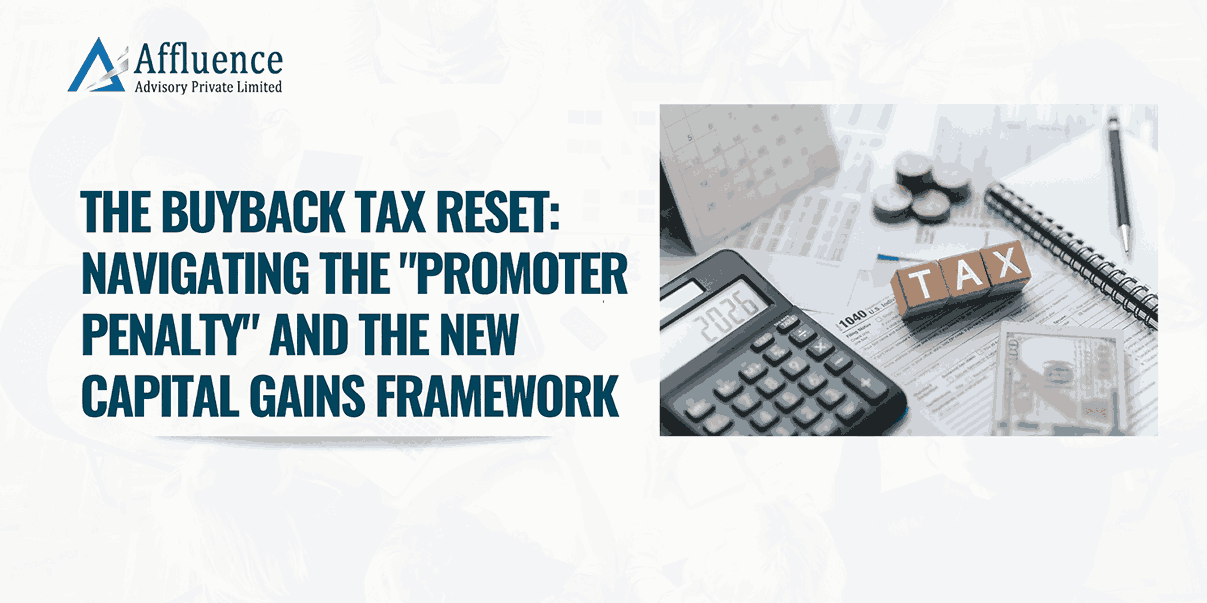
The Union Budget 2026 has fundamentally rewritten the rules for returning capital to shareholders. The immediate impact is already visible in how boards are thinking about payout structures and shareholder distributions. Starting April 1, 2026, the landscape shifts. We are returning to a more nuanced Capital Gains framework. While this is a definitive win for minority shareholders, it introduces a “Promoter Penalty” that changes the math for every MNC and listed entity in India.
For General Counsel and C-Suite executives, the “dividend vs. buyback” debate is no longer a routine compliance check; it is now a high-stakes exercise in capital engineering.
1. From Compliance to Strategy: A Board-Level Reassessment of Buybacks
Historically, buybacks were often treated as a tax-efficient “autopilot” for cash distribution. Post-Budget 2026, the board’s role has shifted from mere approval to deep strategic interrogation.
The Shift in Fiduciary Scrutiny
Directors must now evaluate not just the quantum of the buyback, but the specific tax friction it creates for different classes of investors. This reassessment is no longer optional; it is a fiduciary necessity to ensure that the method of distribution does not unfairly prejudice one group over another.
2. Decoding the Shift: Key Structural Changes in Budget 2026
The primary change is a move away from the “Deemed Dividend” regime to a Capital Gains framework.
Restoring the Cost-Deduction Principle
Previously, shareholders were taxed on the full buyback proceeds as income, regardless of what they paid for the shares. Now, the cost of acquisition is deductible, and gains are taxed at 12.5% (LTCG) or 20% (STCG). This restores the fundamental principle of taxing only the “profit,” making buybacks attractive again.
3. The New Governance: Strategic Implications Beyond the Tax Ledger
The reform introduces a layer of governance complexity. Boards must now account for “Tax Equity.”
Balancing Stakeholder Net-In-Hand. Since the tax burden is no longer uniform across the registry, the decision to opt for a buyback over a dividend must be supported by a clear rationale. Boards must document why a specific payout mechanism was chosen, especially when the “Promoter Penalty” creates a conflict of interest between controlling and minority shareholders.
4. One Transaction, Two Realities: The Divergent Shareholder Experience
Budget 2026 creates a bifurcated outcome. A single corporate action now results in two vastly different financial realities.
Case Study: The ₹1,000 Payout
Consider a company announcing a buyback at ₹1,000 per share.
- The Minority Shareholder: Bought at ₹600. They pay 12.5% tax only on the ₹400 gain.
- The Promoter: Also bought at ₹600. However, they trigger the surcharge, paying a significantly higher effective rate on that same ₹400 gain.
5. Casting a Wider Net: The Expanded Scope of “Promoter” Classification
The government has tightened the definition of who qualifies as a “Promoter” to prevent tax leakage through complex holding structures.
Identifying “Deemed Promoters”
The classification now extends beyond the 20% holding rule to include:
- Significant Influence: Entities holding 10% or more with board representation.
- The Relative Clause: Shares held by immediate family members are aggregated to trigger the penalty.
- MNC Parentage: Global parents are now almost universally captured under this net.
The Three-Way Simulation
Companies must run simulations- Dividend vs. Buyback vs. Capital Reduction, before every distribution. Governance is no longer just about following the law; it’s about optimising for a fragmented tax reality.
6. Ending the Autopilot: Why Buybacks Are No Longer the Default Route
For years, buybacks were the path of least resistance. Under the new regime, the “Default Route” has been replaced by a “Case-by-Case Analysis.”
When Dividends Outperform Buybacks
If a company has a low cost of acquisition (e.g., a founder who started the company at ₹1 per share), the tax on gains for the promoter might actually exceed the tax on a dividend. In such cases, the board might find that a simple dividend is more “tax-neutral” for the controlling group.
7. The Distribution Matrix: Re-examining Modern Payout Mechanisms
Boards are now forced to look beyond the binary choice of Dividends vs. Buybacks.
The Rise of Alternative Extraction
- Capital Reduction: A more court-intensive process under Section 66, but one that allows for a nuanced return of capital that may bypass certain buyback surcharges.
- Staggered Buybacks: Executing smaller, frequent buybacks to manage tax outgo over multiple fiscal years.
8. The Boardroom Checklist: 5 Critical Questions for Leadership
To maintain decision defensibility, boards should address the following:
- Cost Basis Analysis: What is the weighted average cost of acquisition for our top 10 shareholders?
- Repatriation Impact: How does the “Promoter Penalty” impact our MNC parent’s global tax credit position?
- Governance Documentation: Are we adequately documenting the “fairness” of this payout to minority holders?
- Regulatory Conflict: Does the buyback price align with SEBI’s “fair value” while remaining tax-efficient?
- Market Signal: What does this choice say about our internal valuation of the company?
9. From Gatekeepers to Architects: The Evolution of the GC and Company Secretary
The General Counsel (GC) and Company Secretary (CS) are now Capital Architects.
Bridging the Functional Silos
They must facilitate deep collaboration between the Tax Department (to model rates), Finance (to manage liquidity), and Investor Relations (to manage the narrative). The legal structure of the payout must now align perfectly with the financial goals of the board.
10. Defensibility and Equity: Maintaining Governance Integrity
Since tax outcomes are now unequal, the risk of “Oppression and Mismanagement” claims increases.
Mitigating Legal Risk
A board must ensure that the choice of a buyback isn’t seen as “favouring” the promoter’s tax position over the minorities, or vice-versa. Utilising independent fairness opinions and detailed “Tax Impact Simulations” in board minutes is the new gold standard for defensibility.
11. The Signal in the Noise: Buybacks as a Proxy for Corporate Confidence
In the post-2026 era, choosing a buyback despite the Promoter Penalty is a Power Signal.
The “Skin in the Game” Message
It demonstrates that the promoters are willing to absorb a higher tax friction to reward minority holders and reduce the share count. It tells the market: “We believe our stock is so undervalued that we will pay a premium tax to buy it back.”
12. Boardroom Takeaways: Success in the Post-2026 Regime
Success in this new era requires Scenario Modelling.
13. Illustrative Tax Impact: A Quantitative Comparison
| Shareholder Type | Taxable Amount | Applicable Rate | Tax Paid | Net in Hand |
|---|---|---|---|---|
| Minority (Public) | ₹800 (Gains) | 12.5% | ₹100 | ₹900 |
| Promoter (Corp/MNC) | ₹800 (Gains) | 22%* | ₹176 | ₹824 |
| Promoter (Individual) | ₹800 (Gains) | 30%* | ₹240 | ₹760 |
Below is a model of a ₹1,000 return on capital where the original cost was ₹200 (Gain = ₹800).
14. The Payout Snapshot: Choosing Your Vehicle
Strategic Conclusion
The 2026 regime rewards companies with a high cost-basis and punishes those with deep, unrealised gains. For the modern C-Suite, the mandate is clear: Analyse, Model, and Document.
Disclaimer: This article provides general information existing at the time of preparation and we take no responsibility to update it with the subsequent changes in the law. The article is intended as a news update and Affluence Advisory neither assumes nor accepts any responsibility for any loss arising to any person acting or refraining from acting as a result of any material contained in this article. It is recommended that professional advice be taken based on specific facts and circumstances. This article does not substitute the need to refer to the original pronouncement.
CLICK HERE DOWNLOAD PDF