Author: Ankit Baid, Research Analyst at Affluence Advisory
In an era when traditional IPOs demand upwards of 18 months and substantial investment in underwriting costs, forward-thinking companies are increasingly embracing reverse mergers as a pragmatic shortcut to public market listing. The trend reached a crescendo in 2024-2025, with high-profile exits like Zepto, Razorpay, and Meesho leveraging this mechanism to relocate their domiciles from offshore jurisdictions back to India while simultaneously gaining public market access. For private businesses seeking rapid liquidity, operational autonomy, and strategic tax advantages, a reverse merger has transformed from a niche corporate restructuring tactic into a mainstream alternative that demands serious consideration.
Understanding the Architecture: Beyond the Jargon
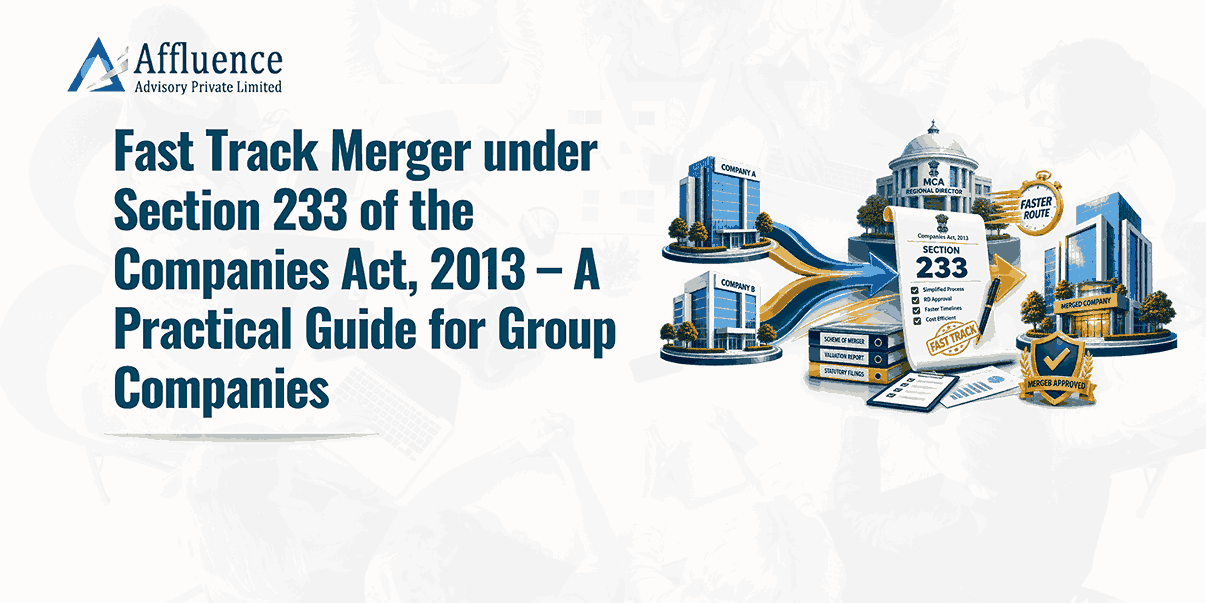
A reverse merger—often called a Reverse Takeover (RTO)—inverts the traditional M&A narrative. Instead of a larger public company acquiring a smaller private entity, the script reverses: a private company strategically orchestrates the acquisition of a smaller, dormant public company (colloquially termed a “shell”). The result is a rapid transformation of the private entity into a listed public company without the protracted and capital-intensive machinery of an Initial Public Offering.
Also Read: India’s Simple Agreement for Future Equity (SAFE): Navigating a New Frontier in Startup Funding
The transaction unfolds through a choreographed sequence of steps:
The entire process hinges on a share exchange mechanism. Private company shareholders exchange their holdings for shares in the dormant public shell, effectively transferring ownership and control. Simultaneously, the management team, board composition, and operational direction of the private entity assume stewardship of the public vehicle. The listed entity undergoes a complete rebranding—name, business operations, and strategic direction all realigned to reflect the acquiring private firm’s identity. Critically, the private company’s core assets, intellectual property, revenue streams, and operational structure are fully integrated into the public entity, transforming it from a dormant shell into an operating business.
An essential compliance layer: When a private company acquires more than 26% shareholding and attains control over a listed entity, SEBI’s Substantial Acquisition of Shares and Takeovers (SAST) Regulations, 2011, mandates an open offer to all public shareholders. This mechanism protects minority shareholders by requiring the acquiring party to make a public tender for additional shares at a fair valuation, preventing a concentration of ownership without adequate compensation to other stockholders.
Why Private Companies Choose RTOs Over IPOs: The Economics and Strategy
The decision to pursue a reverse merger rather than a traditional IPO represents a calculated trade-off between speed, cost, regulatory scrutiny, and capital-raising objectives.
|
Factor |
Reverse Merger (RTO) |
Traditional IPO |
|
Timeline to Listing |
6–9 months (fast-track: 3–4 months post-2024 reforms) |
12–18 months or longer |
|
Direct Costs |
Lower (minimal underwriting, legal, and marketing expenses) |
Substantially higher (investment banker fees, roadshow expenses, regulatory filings) |
|
Market Sentiment Vulnerability |
Moderately insulated; less dependent on market conditions |
Highly sensitive to equity market cycles and investor appetite |
|
Primary Capital Raised |
Primarily a listing mechanism; separate capital raise required |
Direct primary capital infusion from public investors |
|
Shareholder Liquidity |
Immediate market-traded shares for existing holders |
Phased liquidity post-IPO lock-in periods |
The Strategic Imperative: For founders and promoters seeking to unlock shareholder liquidity without diluting operational control or enduring prolonged IPO roadshows, RTOs represent a compelling alternative. The mechanism is particularly attractive for rapidly scaling technology and fintech companies facing pressure to achieve public market status while maintaining governance autonomy.
The Tax Architecture: Unlocking Hidden Value Through Section 72A
One of the most compelling drivers of reverse merger activity in India is the tax efficiency facilitated by Section 72A of the Income Tax Act, 1961. This statutory provision allows the newly amalgamated entity to inherit and utilize the accumulated losses and unabsorbed depreciation of the merging company.
Consider a practical scenario: A profitable software-as-a-service (SaaS) startup executes a reverse merger with a dormant, loss-making listed company that accumulated substantial tax losses over years of inactivity. The merged entity can now carry forward these historic losses, systematically offsetting future profits against this tax shield. In a company projecting ₹50 crores in annual profits with inherited accumulated losses of ₹100 crores, the tax benefit could translate into years of substantially reduced tax liability—a windfall equivalent to a multi-crore capital injection.
However, recent legislative amendments have introduced constraints: The Union Budget of February 2025 proposed amendments to Sections 72A and 72AA that cap the carry-forward of losses at eight years from the original computation date, restricting sequential M&A transactions designed purely for tax optimization. These changes specifically target tax arbitrage while preserving legitimate business restructuring. Companies executing RTOs must now demonstrate genuine business continuity and integration rather than mere tax motivation, with the burden of proof resting on regulatory authorities to verify operational synergies.
India’s Regulatory Gauntlet: A Multi-Layered Compliance Framework
The Indian regulatory apparatus governing reverse mergers has evolved into a sophisticated, multi-tiered system designed to balance corporate restructuring flexibility with investor protection. Understanding this framework is essential for successful execution.
The Companies Act, 2013 (Sections 230–232): The Foundational Layer
The statutory bedrock governing RTOs falls under the schemes of compromise, arrangement, and amalgamation provisions. The National Company Law Tribunal (NCLT) serves as the primary approving authority, with responsibility to ensure fairness to all stakeholder classes. Section 232(3)(h) enshrines the opt-out provision, guaranteeing dissenting shareholders of the listed shell company the right to seek fair valuation of their shares rather than accepting the merger terms—a critical safeguard preventing minority oppression.
Recent regulatory acceleration: The September 2024 amendments to the Companies (Compromises, Arrangements and Amalgamations) Rules, 2016, introduced Rule 25A(5), enabling eligible companies to pursue fast-track merger routes that bypass NCLT approval, compressing timelines to 3–4 months. Zepto’s January 2025 reverse merger capitalized on this expedited pathway, demonstrating the practical impact of this regulatory evolution.
SEBI’s Regulatory Oversight: Investor Protection and Market Integrity
The Securities and Exchange Board of India enforces a complementary regulatory framework through three distinct regulation sets:
SEBI (Listing Obligations and Disclosure Requirements) Regulations, 2015 (LODR): Prior to consummating an RTO, the acquiring company must obtain a No-Objection Certificate (NOC) from the stock exchanges (BSE and NSE). This checkpoint ensures that the transaction aligns with listing standards and that disclosure obligations are comprehensively met.
SEBI (Issue of Capital and Disclosure Requirements) Regulations, 2018 (ICDR): RTOs are classified as “Indirect Listings,” a designation that triggers mandatory lock-in periods on promoter shareholdings—mirroring restrictions imposed on IPO sponsors. This regulatory alignment prevents rapid share sales immediately post-listing, which historically plagued certain reverse mergers with price manipulation and investor harm.
SEBI (SAST) Regulations, 2011 (Takeover Code): While NCLT-approved mergers often receive exemptions from triggering mandatory open offers post-closing, the initial acquisition phase—when the private company purchases exceeding 26% stakes—unambiguously triggers open offer obligations. This ensures that minority public shareholders receive fair opportunity to exit at a specified valuation.
Disclaimer: This article provides general information existing at the time of preparation and we take no responsibility to update it with the subsequent changes in the law. The article is intended as a news update and Affluence Advisory neither assumes nor accepts any responsibility for any loss arising to any person acting or refraining from acting as a result of any material contained in this article. It is recommended that professional advice be taken based on specific facts and circumstances. This article does not substitute the need to refer to the original pronouncement.
CLICK HERE DOWNLOAD PDF