Today, financial management is not just a separate branch of management or rather financial management doesn’t just mean managing the funds of the company. It has extended its hands to optimising the capital of the company in an effective and efficient manner through various modes of capital restructuring.
Capital restructuring is a mechanism through which a company does re-engineering of its capital to identify the optimum capital combination, in such a manner that the cost of raising the fund is kept minimal and there is also no room for idle capital.
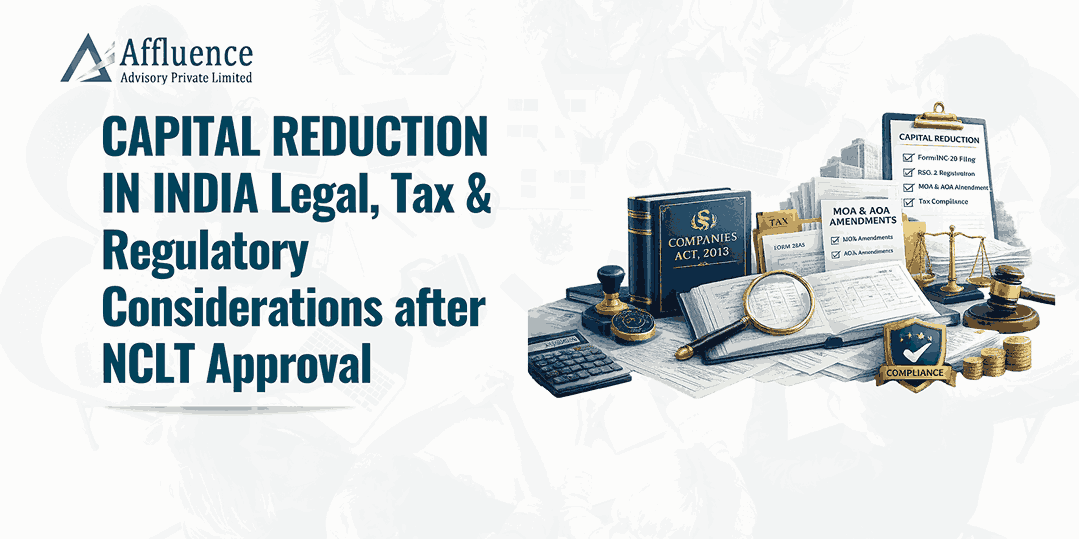
One such mode of capital restructuring is Capital Reduction. Capital Reduction in India is governed under section 66 of Companies act, 2013, and it requires the approval of National Company Law Tribunal (NCLT). Once you get green signal from the NCLTfor capital reduction, the major work starts.
In this article we’re going to talk about the action and implications which are essential to complete the process of capital restructuring as the process doesn’t end on receipt of the NCLT order.
These are few important steps to be taken care of like legal, tax related points etc.
- FILING THE ORDER OF NCLT WITH ROC-
The company shall file the order of NCLT with ROC in Form INC-28. i.e., the company shall submit a certified copy of the Tribunal’s order showing –
- the amount of share capital;
- the number of shares into which it is to be divided;
- the amount of each share; and
- the amount, if any, at the date of registration deemed to be paid-up on each share,to the Registrar within the period of 30 days from the date of receipt of the certified copy of the order.
The ROC shall register the same and issue a certificate to that effect in form RSC-7 and once ROC register it, the company shall give effect to capital reduction.
Further, the procedure depends upon the mode in which shares are held:
In case the shares are in physical form, the company shall obtain share certificate from the share holders and cancel or alter the same, as applicable to give effect to capital reduction and in case the shares are held in demat form the company shall intimate the same to the relevant depository and its registrar of transfer agent (RTA) to undertake corporate action and make necessary changes in shareholders demat accounts and the reduced shares shall be credited to shareholders demat account after such corporate action.
- TAX IMPLICATIONS OF CAPITAL REDUCTION:
“No tax implications shall arise in the hands of the company”.
When a company reduces its capital, the consideration of reduced capital is paid to the shareholders either in cash or in kind and it is taxable in the hands of shareholders in two parts i.e., Deemed Dividend and Capital Gain.
When a company reduces its capital and makes payments to its shareholders, such payment is treated as dividend to the extent of accumulated profits.
With effect from April 01, 2020, Dividend Distribution Tax (“DDT”) was abolished in the hands of the company and dividend has become taxable in the hands of the shareholders and therefore, such deemed dividend shall become taxable in the hands of the shareholders as ‘Income from Other Sources’ and tax shall be levied at the rates applicable to such shareholders depending upon the category of the person (e.g., individuals, domestic companies, foreign companies, etc.)
Accordingly, in case of capital reduction, where shares are cancelled and the shareholder’s rights are extinguished, such transaction is considered as a transfer under section 2(47) of the Income Tax Act and may give rise to capital gains.
“The consideration for such transfer shall be the amount received by the shareholder, whether in cash or in kind, to the extent it exceeds the portion already treated as deemed dividend.”
After the approval of capital reduction by NCLT, the Company still has to ensure that proper compliance with all applicable legal and regulatory requirements.
This includes giving effect to the approved scheme, making alteration in MOA and AOA
(MOA and AOA must be updated to reflect the reduced share capital and altered share structure), ensuring all the conditions mentioned in the NCLT order are followed, implementation of scheme to the SEBI (if listed entity) etc.
Apart from this proper disclosure of Capital reduction should be made in the Financial statements and Board Report so that stakeholders are fully informed.
Further, there are certain modes of the Reduction of share capital where the approval of NCLT is not required. These are:
- Where the shares are forfeited for non-payment of call money,
- Where the company buy-back of its own securities by a company under Section 68 of the Companies Act, 2013,
- Where redeemable preference shares are redeemed in accordance with the provisions of section 55 of the Companies Act, 2013.
A well- executed capital reduction not only ensures compliance with the law but also but also built confidence among stakeholders. While the NCLT order provides the legal basis for reduction, the effectiveness of the process depends on timely compliance with ROC requirements.
Disclaimer: This article provides general information existing at the time of preparation and we take no responsibility to update it with the subsequent changes in the law. The article is intended as a news update and Affluence Advisory neither assumes nor accepts any responsibility for any loss arising to any person acting or refraining from acting as a result of any material contained in this article. It is recommended that professional advice be taken based on specific facts and circumstances. This article does not substitute the need to refer to the original pronouncement.
CLICK HERE TO DOWNLOAD PDF