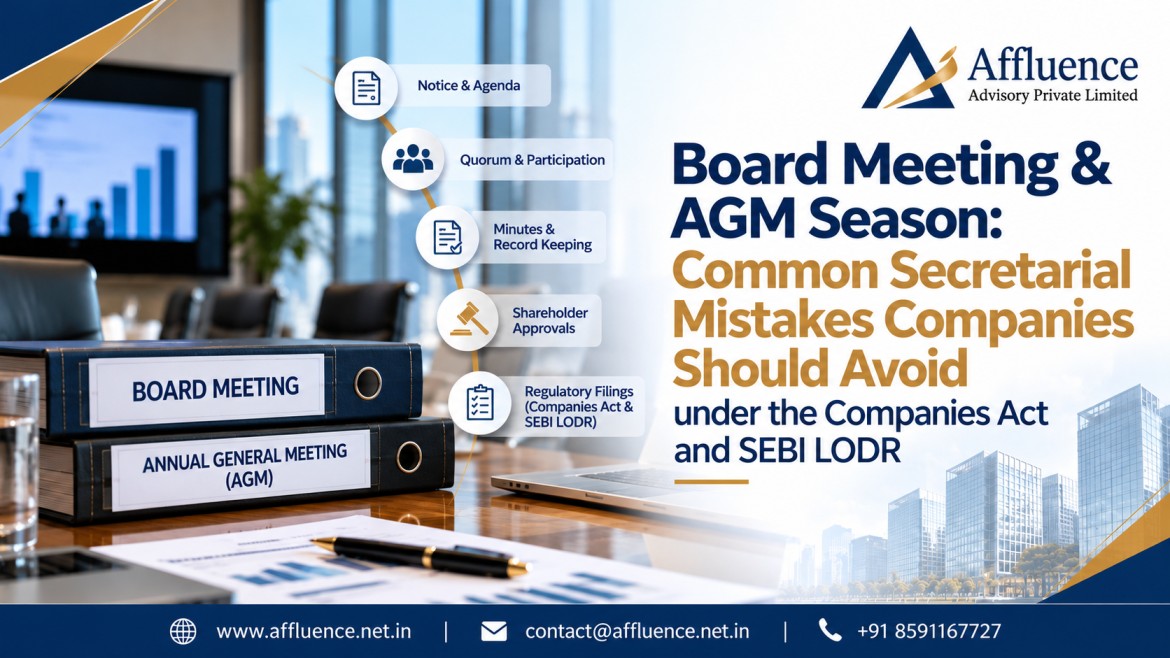
The period leading up to the Annual General Meeting (“AGM”) is the ultimate testing ground for a company’s secretarial, compliance, and legal teams. Financial statements are being finalised, the Board is meeting to approve financials, and multiple filings are lined up.
For unlisted companies, the standard is the Companies Act, 2013 and Secretarial Standards (SS-1 & SS-2). However, for listed entities, the compliance stakes skyrocket. SEBI’s Listing Obligations and Disclosure Requirements (LODR) regulations add layers of absolute timelines, trading windows, and mandatory disclosures that leave zero room for human error.
Here are 20 common secretarial mistakes that companies should watch out for during the Board Meeting and AGM season.
Category A: SEBI LODR & Stock Exchange Compliance Traps
- The “30-Minute” Post-Board Meeting Disclosure Slip
The Trap: After a long, exhausting Board Meeting where financial results or dividends are approved, the secretarial team takes a breather or starts drafting the detailed minutes before notifying the exchanges.
SEBI Mandate (Regulation 30): The outcome of the Board Meeting—specifically regarding financial results, dividends, fund-raising, or buybacks—must be disclosed to the stock exchanges within 30 minutes of the conclusion of the meeting.
Takeaway: Prepare the draft “Outcome of Board Meeting” before the meeting starts. As soon as the Chairman sounds the gavel, update the exact figures and upload to the exchange portal immediately.
- Confusing the “Prior Intimation” Timelines for Board Meetings
The Trap: Giving a standard 7-day notice to directors but forgetting that the Stock Exchanges require a separate, strict advance intimation notice.
SEBI Mandate (Regulation 29): The stock exchanges must receive a prior intimation at least 2 clear working days in advance for matters like buybacks or voluntary delisting, and at least 11 working days for changes in the form or nature of securities. Crucially, for meetings discussing financial results, a prior intimation of at least 5 clear working days (excluding the date of intimation and the date of the meeting) is mandatory.
Takeaway: Never sync your board notice only with the directors. The stock exchange intimation calendar must be mapped out separately.
- Delayed Trading Window Closure and Re-opening Advertisements
The Trap: Under SEBI (Prohibition of Insider Trading) Regulations, trading windows must close from the end of every quarter until 48 hours after financial results are made public. A common mistake is failing to formally notify designated persons or miscalculating the exact 48-hour release time.
Takeaway: Automate email triggers to all “Designated Persons” exactly at the quarter-end date, and do not permit trading until a full 48 hours have elapsed post-exchange filing.
- The 24-Hour Regulation 30 Materiality Disclosure Window
The Trap: If the Board takes a material strategic decision (other than financial outcomes), the team delays the disclosure, believing it can be clubbed with other post-meeting actions.
SEBI Mandate: Any material event or information determined under Regulation 30 must be disclosed to the stock exchanges as soon as reasonably possible, and no later than 24 hours from the occurrence of the event.
Takeaway: Implement a strict internal framework to identify material items instantly.
- Mismatch Between the “Exchange Outcome” and Final Board Minutes
The Trap: The quick 30-minute summary uploaded to the stock exchange contains minor narrative or numerical variations compared to the detailed minutes compiled 20 days later under SS-1.
SEBI & RoC Impact: Inconsistencies between what is broadcast to investors via the exchange and what is officially written in the statutory minutes book can invite severe enforcement action for misleading the market.
Takeaway: The official minutes must precisely ground and align with the material facts disclosed to the stock exchange.
- Stale Corporate Websites (Regulation 46 & 62)
The Trap: Updating the physical investor documents but forgetting to mirror those updates on the company’s functional website under the dedicated “Investor Relations” section.
SEBI Mandate: Listed entities must maintain a functional website. Under Regulation 46, changes in board composition, financial updates, shareholding patterns, and official notices must be uploaded to the website within 2 working days of the event. Takeaway: A static website is a non-compliant website. Treat your web compliance workflow as a parallel track to your exchange filings.
- The Dividend Disclosure and Record Date Trap ((SEBI LODR – Regulation 29 & 42)
The Trap: Proposing a dividend at a Board Meeting but failing to coordinate the required multi-layered notifications simultaneously.
SEBI Mandate: Listed entities must give a prior intimation of at least 2 working days before a Board Meeting where a dividend is recommended. Furthermore, the company must provide an advance notice of at least 7 working days (excluding the date of intimation and the record date) to the stock exchanges before fixing the Record Date for dividend payment.
Takeaway: Never declare a dividend without an aligned dual-timeline calendar that tracks both the pre-board intimation and the structural pre-record date filing windows.
- Delaying the Annual Report dispatch beyond the 21-Day window ((SEBI LODR – Regulation 34)
The Trap: Sending out the financial results and AGM notice on time but delaying the dispatch of the full, comprehensive Annual Report to shareholders.
SEBI Mandate: Listed entities must send the soft copy of the full Annual Report (containing the audited financial statements, Board’s report, and Corporate Governance report) to all shareholders not later than the day of dispatch of the notice of the AGM. It must also be submitted to the stock exchanges on the same day it is sent to shareholders.
Takeaway: Treat the AGM Notice and the Annual Report as a single, inseparable dispatch package to prevent severe procedural defaults.
- Overlooking the Secretarial Audit Report (Form MR-3) attachment (Section 204)
The Trap: Preparing the main Board’s Report but failing to physically attach or cross-verify the structural observations made by the Practising Company Secretary (PCS) in the Secretarial Audit Report.
Companies Act Mandate: Every listed company must annex a Secretarial Audit Report (Form MR-3) to its Board’s Report. Crucially, the Board is legally mandated to explain in full any qualification, observation, or adverse remark made by the auditor in that report.
Takeaway: Review the final MR-3 draft well in advance of the financial approval Board Meeting to ensure the Board’s response is structured, accurate, and embedded directly within the main report text.
Category B: Board Meeting Procedural & Secretarial Standard Faults
- Neglecting Pre-Meeting System Tests for Virtual / Hybrid Attendance (SS-1)
The Trap: Allowing directors to join via Video Conferencing (VC) without checking statutory compliance guidelines for electronic participation.
Secretarial Standards Mandate: Under SS-1 and MCA guidelines, the company must provide robust audio-visual connectivity, prevent unauthorized access, and ensure that the recording clearly captures the individual votes and identification roll calls of remote directors.
Takeaway: Run a mandatory, documented dry-run tech audit 24 hours before the Board Meeting. Ensure the final minutes specifically note the physical location from which the Chairman and Company Secretary coordinated the digital platform.
- Tracking only the Number of Board Meetings and ignoring the 120-Day Gap
The Trap: A company holds meetings in April, July, November, and February. While it hits the four-meeting quota, the gap between July and November might exceed 120 days depending on the exact dates.
Companies Act (Section 173): Mandates a maximum gap of 120 days between two consecutive meetings.
Takeaway: Maintain a “meeting date and gap” tracker alongside your standard tracker. Also, ensure your Articles of Association (AOA) do not mandate an even shorter gap.
- Treating the Board Meeting notice as a mere formality
The Trap: The meeting date is changed after the agenda has been circulated, but the revised notice or supporting documentation is not systematically tracked or archived.
Takeaway: Under SS-1, you must maintain strict documentary proof of the date of notice issue, mode of delivery, original agenda, notes on agenda, and subsequent modifications.
- Ignoring the Stricter Board Quorum Mandates for Top Listed Entities
The Trap: Relying on the general Companies Act rule for quorum (1/3rd of total strength or 2 directors, whichever is higher).
SEBI Mandate (Regulation 17(2A)): For the top 2,000 listed entities by market capitalisation, the quorum is one-third of the board strength or three directors, whichever is higher, and it must include at least one Independent Director.
Takeaway: If you fall into this tier, you cannot commence a valid board meeting if no Independent Director is present in the room or on the VC line. Crucially, verify if your company’s Articles of Association (AOA) provide a stricter or different requirement regarding quorum for the Board Meeting. If the AOA provides otherwise, the AOA rules must be strictly followed.
- Overstepping the legal boundaries of “Circular Resolutions”
The Trap: Approving high-stakes, critical matters via email routing or circular signatures to save time between formal meetings.
Companies Act (Section 175 & SS-1): Core matters—such as approving financial statements, the Board’s Report, diversification strategies, or major borrowings, cannot be passed via circular resolution. They must be discussed at a physical or video-conferenced meeting.
Takeaway: Restrict circular resolutions strictly to routine administrative matters, and ensure they are formally noted in the minutes of the immediate next Board Meeting.
- Failing to track the 15-Day draft and 30-Day signing deadlines
The Trap: Treating the formal drafting and signing of minutes as a loose, flexible administrative chore.
Secretarial Standards (SS-1 & SS-2): Draft minutes must be circulated to all directors within 15 days of the conclusion of a Board Meeting. The final minutes must then be entered into the minutes book and signed within 30 days.
Takeaway: Log the exact date of entry in your statutory records. Missing the 30-day signing window is a direct compliance violation under Section 118.
- The trap of inconsecutively numbered pages in the Minutes Book
The Trap: Printing or binding the minutes of individual meetings without maintaining an unbroken, continuous page sequence across the volume.
SS-1 / SS-2 Mandate: The pages of the Minutes Books must be consecutively numbered across the entire financial year or book volume, not just numbered 1 to 5 for an individual meeting.
Takeaway: Implement strict sequential pagination controls to prevent regulatory flags regarding the integrity of your statutory logs.
Category C: AGM, Voting & Shareholder Transparency Pitfalls
- Miscalculating the Stricter “Clear Days” Notice Timeline
The Trap: Assuming that counting 21 days on a calendar satisfies the legal requirement for an AGM notice.
Companies Act (Section 101): An AGM requires a minimum of 21 clear days’ notice. “Clear days” means you must completely exclude the day the notice is served and the day of the AGM itself. Furthermore, if the notice is sent via post or courier, you must add an extra 48 hours to the timeline.
Takeaway: Chart a meticulous timeline: Board Approval → Dispatch Day (+48 hours if by post) → 21 Clear Days → AGM Date.
- Copy-Pasting the AGM Notice without updating the Explanatory Statement
The Trap: Re-using last year’s text as a template and forgetting to update updated director tenures, revised remuneration structures, or the specific interest matrices of KMPs.
Companies Act (Section 102): Requires a comprehensive explanatory statement for all “special business” items, detailing every material fact.
Takeaway: Prepare explanatory statements item-by-item. Verify which specific directors or KMPs are interested, and ground all factual disclosures in fresh, verified data.
- Mismanaging proxy requirements and AGM Quorum Rules
The Trap: Counting proxies toward the statutory quorum requirement during the AGM setup.
Companies Act (Section 103): While a proxy represents a member for voting purposes, proxies do not count toward establishing a statutory quorum unless explicitly allowed by your AOA.
Takeaway: Differentiate between members personally present and proxies in your log. Ensure all proxy forms (Form MGT-11) are received and verified at least 48 hours before the meeting.
- Missing Mandatory Statutory Declarations in the Board’s Report
The Trap: Drafting a comprehensive financial review but failing to include mandatory standalone declarations.
The Law: The Board must explicitly state that the company has complied with the applicable Secretarial Standards (SS-1 and SS-2) and, if applicable, that it has constituted an Internal Complaints Committee (ICC) under the POSH Act.
Takeaway: Missing these precise statutory phrases in the final text of the Board’s Report is treated by the RoC as an absolute disclosure failure.
- Recording Minutes as a bare summary of Resolutions only
The Trap: Writing minutes that merely state: *”RESOLVED THAT the financials be approved.”*
Section 118 Mandate: Minutes must provide a fair, objective, and correct summary of the actual proceedings. For Board Meetings, capture the core deliberations, queries raised by independent directors, and institutional dissents (SS-1). For general meetings, record the narrative flow and voting mechanics (SS-2).
- Delaying the submission of Voting Results and Scrutiniser Reports
The Trap: Treating the compilation of e-voting and physical voting results as a relaxed post-AGM activity.
SEBI Mandate (Regulation 44(3)): The listed entity must submit details regarding the voting results to the stock exchange within 2 working days of the conclusion of the general meeting, accompanied by the formal Consolidated Scrutiniser’s Report.
Takeaway: Work closely with your designated Scrutiniser to ensure the report is signed, digitized, and uploaded in the mandatory XBRL format well within the 2-day window.
- Treating ROC Filings as an untracked post-meeting exercise
The Trap: Celebrating the successful conclusion of the AGM while allowing the statutory filing windows to slip past.
The Law: The AGM triggers a strict countdown: 30 days for filing financial statements (Form AOC-4) and 60 days for the Annual Return (Form MGT-7/7A).
Takeaway: Deploy an integrated compliance tracker before the meeting cycle begins. A single missed filing date results in compounding daily penalties and tags the company as non-compliant.
The Master Compliance Checklist (Listed Entity)
Board Meeting Cycle
- Prior Intimation: Filed with Stock Exchanges (5 working days for results; 2 days for other items).
- Trading Window: Formally closed at quarter-end and communicated to all Designated Persons.
- 120-Gap Check: Verified that the maximum interval between consecutive meetings is not breached.
- Quorum Verification: Met the 1/3rd or 3-director threshold, ensuring at least one Independent Director is present (for Top 2,000 entities).
- Post-Meeting Outcome: Uploaded to stock exchanges within 30 minutes of conclusion.
- Draft Minutes: Circulated to all directors within 15 days of the meeting.
AGM & Voting Cycle
- AGM Notice Period: Verified 21 clear days (+48 hours if dispatched via post).
- Website Updates: Notice and financial reports hosted on the corporate portal within 2 working days.
- Explanatory Statements: Itemized and reviewed for fresh KMP/Director interest vectors.
- Proxy Forms: Logged, cross-checked against the register, and validated 48 hours prior.
- Voting Results: Consolidated Scrutiniser’s Report uploaded to exchanges within 2 working days.
- Final Minutes Book: Entered, sequentially paginated, and signed within 30 days.
- Post-AGM Tracker: Active tracking deployed for Forms AOC-4, MGT-7, and associated MGT-14 resolutions.
Conclusion
Corporate governance for a listed entity is an intricate matrix where the Companies Act, Secretarial Standards, and SEBI LODR must all operate in perfect, flawless harmony. The errors that attract the steepest fines are rarely intentional acts of fraud; they are almost always small, procedural omissions—a 30-minute delay in an exchange filing, an incorrectly calculated “clear day,” or a copy-pasted template statement.
The golden rule for compliance officers remains absolute: Do not just track if the resolution passed; ensure that every regulatory, listing, and secretarial step taken to reach that resolution was perfectly compliant.
CLICK HERE TO DOWNLOAD PDF
Disclaimer: This article is intended for general informational purposes and should not be construed as legal or professional compliance advice. Listed entities must strictly consult the Companies Act, 2013, the SEBI LODR Regulations, 2015, and the latest Master Circulars before executing corporate actions.