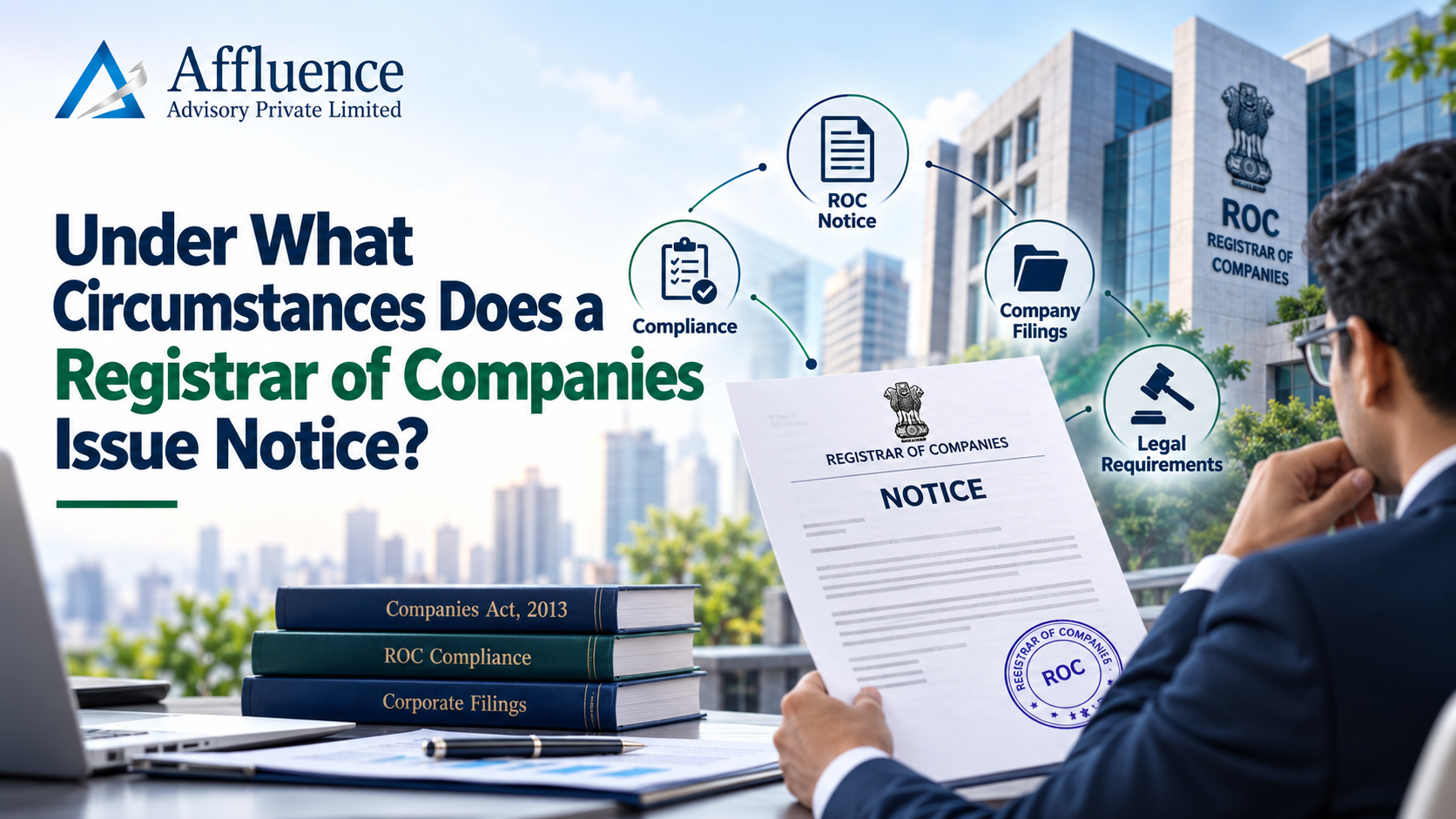
Running a company is not only about earning money or offering a good product or service. There is also a fair amount of paperwork and legal responsibility that comes with it. In India, every registered company has to follow the Companies Act, 2013, which is administered by the Ministry of Corporate Affairs (MCA). The officer who keeps a check on companies at the state level is the Registrar of Companies, better known as the ROC.
Most companies concentrate on growth and profit, and compliance slowly slips down the list. Filings get delayed, the registered office is not looked after, or governance rules are ignored. When that happens, the ROC steps in. The Companies Act gives the Registrar the power to send notices, Show Cause Notices (SCNs) and inquiry directions to the company and to the officers who are in default.
These notices are not just a formality. The ROC uses them to ask for an explanation, to push the company to fix a lapse, or to start action against it. If the company ignores them, the consequences can be serious: monetary penalties, disqualification of directors, removal of the company’s name from the register and, in some cases, criminal prosecution. Knowing when and why the ROC sends a notice is useful for anyone studying business law or running a company, because it helps you stay out of trouble.
The main situations in which the ROC issues a notice:
- Failure to File Statutory Returns (Section 92 & Section 137)
The ROC keeps track of what companies file on the MCA portal. If a mandatory annual filing is missed, the company usually receives a default notice first, and then a Show Cause Notice if the default continues.
- Section 92(5): The Annual Return (Form MGT-7 or MGT-7A) has to be filed within 60 days of the Annual General Meeting (AGM). Missing this deadline is a default.
- Section 137(3): The Financial Statements (Form AOC-4 or AOC-4 XBRL) must be filed within 30 days of the AGM.
- Section 10A(2): The Declaration of Commencement of Business (Form INC-20A) must be filed within 180 days of incorporation.
2.Physical Non-Verification or Absence of Registered Office (Section 12)
Section 12(9): If the ROC has reasonable cause to believe that a company is not carrying on any business or operations at its registered office, it sends a notice to the company and to all its directors. This often follows a physical visit by ROC officials under the MCA rules. If the company cannot satisfy the verification, strike-off proceedings can follow.
3.Power to Call for Information, Inspect Books and Conduct Inquiry (Section 206)
Section 206 gives the ROC wide powers to look into the affairs of a company.
- Section 206(1): After reviewing filed documents or information received (for example, a complaint or a whistleblower report), the ROC can send a written notice asking the company to provide more information, explanations or specific documents within a set time.
- Section 206(3): If the reply to a Section 206(1) notice is not satisfactory, or if the ROC learns that the business is being run for a fraudulent or unlawful purpose, a second notice can follow ordering a formal Inquiry.
- Section 206(4): A direct notice can be issued when the information available with the ROC shows that the business is being carried on defrauding creditors or members, or for an unlawful purpose.
- Removal / Strike-Off of Company Name (Section 248)
Under Section 248(1), read with the Companies (Removal of Names of Companies from the Register of Companies) Rules, 2016, the ROC sends Form STK-1 (Notice by ROC) to the company and its directors in the following situations:
- The company has not started business within 1 year of incorporation.
- The company has carried on no business or operation for the 2 immediately preceding financial years and has not applied for Dormant Company status under Section 455.
- The subscribers to the Memorandum have not paid the subscription money within 180 days of incorporation (this usually goes hand in hand with a default in Form INC-20A).
- Disqualification and Deactivation of Directors (Section 164 & Section 167)
- Section 164(2): If a company does not file its financial statements or annual returns for 3 consecutive financial years, or fails to repay deposits, interest or dividends for 1 year, the ROC can issue notices, deactivate the Director Identification Numbers (DINs) and mark the directors as disqualified for 5 years across all companies.
- DIR-3 KYC: Rule 12A of the Companies (Appointment and Qualification of Directors) Rules, 2014 allows the ROC to deactivate a DIN if the annual DIR-3 KYC is not filed by September 30.
- Discrepancies in Related Party Transactions & Loans (Section 185 & Section 186)
If a company’s financial statements (AOC-4) show loans to directors, guarantees or investments that go beyond the legal limits without the required special resolution, the ROC can issue a Show Cause Notice for breach of Section 185 (loans to directors) and Section 186 (loans and investments by a company).
- Charge Creation and Modification Defaults (Section 77 to Section 87)
When a company creates or modifies a charge, such as a hypothecation or a bank mortgage, it has to register it in Form CHG-1 or CHG-4 within 30 days. The Registrar can allow this to be extended up to 300 days on payment of additional fees. If the ROC spots secured debts that were never recorded, or late filings, usually through audit reports, it sends a notice asking the company to register the charge or explain the default.
- Complaints from Stakeholders and Inter-Agency Intimations
The ROC can also issue SCNs after receiving complaints or instructions from:
- Shareholders who allege oppression or mismanagement.
- The Serious Fraud Investigation Office (SFIO), Reserve Bank of India (RBI), SEBI or the Income Tax Department, when they report financial irregularities.
- Employees, vendors or creditors who report unpaid dues or fraudulent activity.
How to respond to a ROC notice?
Reply quickly and in an organised way. A late or careless reply can lead to fines, disqualification of directors or strike-off of the company.
- Review and verify. Read the notice carefully. Find the exact section of the Companies Act, 2013 that is cited (for example, Section 206 for inquiry or Section 248 for strike-off) and note the deadline for reply, which is usually 15 to 30 days. Then check the alleged defaults against your own records.
- Cure the default. Before you reply, correct whatever is pending, such as overdue Forms AOC-4, MGT-7 or DIR-3 KYC on the MCA portal. Doing this shows good faith.
- Draft a formal written reply. Answer each allegation point by point. Give clear, factual reasons for the delay (such as administrative delays or portal errors) and attach supporting documents like MCA SRN challans, bank statements or Board Resolutions.
- Submit the reply. The reply should be signed by an authorised director and come with a verification affidavit. File it in person at the ROC office or online through Form GNL-2 on the MCA portal, and keep the submission receipt as proof.
Conclusion & Preventive Measures
The ROC does not send notices just to punish businesses. The aim is to keep companies disciplined and to protect stakeholders. A good reply can limit the damage once a default has happened, but it is far better to avoid getting the notice in the first place.
A few habits go a long way in keeping a company off the ROC’s radar:
- Keep a compliance calendar. Use a tracker, preferably an automated one, so that Form MGT-7, Form AOC-4 and DIR-3 KYC are filed well before the MCA deadlines.
- Look after the registered office. Keep proof that the office is actually in use, such as utility bills, the rent agreement and an updated nameboard, so that a physical verification under Section 12(9) goes smoothly.
- Do regular internal audits. Periodic secretarial and financial audits help you catch missing board resolutions, unrecorded charges (Form CHG-1/4) or unauthorised transactions before the regulator does.
- Update the portal on time. File Form INC-22 as soon as the business address changes, and Form DIR-12 when directors change, so that official communication actually reaches the management.
- Deal with complaints early. Settle shareholder and creditor grievances internally before they turn into formal complaints on the MCA portal, which can lead to Section 206 inquiries.
In the end, compliance should not be seen as a burden. It protects the company and its directors, and it makes the business easier to trust. If these habits become part of day-to-day governance, a company can steer clear of legal trouble and keep its directors safe from disqualification.
CLICK HERE TO DOWNLOAD PDF
Disclaimer: This article provides general information existing at the time of preparation and we take no responsibility to update it with the subsequent changes in the law. The article is intended as a news update and Affluence Advisory neither assumes nor accepts any responsibility for any loss arising to any person acting or refraining from acting as a result of any material contained in this article. It is recommended that professional advice be taken based on specific facts and circumstances. This article does not substitute the need to refer to the original pronouncement.