Introduction – “Statutory Registers are not optional—they are mandatory records forming the legal memory of a company.”
In corporate law, maintaining statutory registers may seem routine, but it is one of the most overlooked areas of corporate compliance. Small mistakes can have significant legal consequences.
Yet, during secretarial audits, due diligence, and MCA inspections, even large corporates are found deficient. The irony is that while registers seem “clerical” in nature, non-compliance can trigger monetary penalties, governance failures, shareholder disputes, and reputational damage.
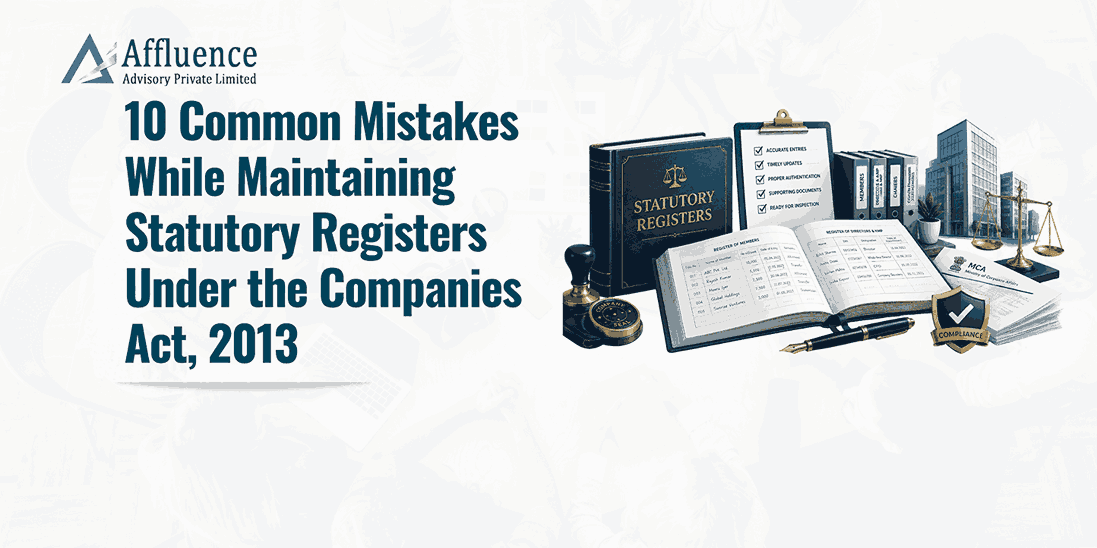
Let’s explore the 10 most common mistakes companies make while maintaining statutory registers:
1. Register of members not updated after allotment/ transfer:
Section 88 requires registers of members and security holders to be always maintained, not annually.
Mistakes: Many a time, the Companies did not match PAS-3 filings and share certificates issued with the Registrar of Members.
Case law reference: MCA v. Geodesic Ltd. (2015) – Non-maintenance of Register of Members was one of the grounds flagged by SFIO in its prosecution of the company, as it hindered the identification of genuine shareholders.
2. Inaccurate register of members (mgt-1):
As per section 88 of the Companies Act, 2013, it is a statutory obligation to maintain an accurate Register of Members, as it serves as conclusive evidence of membership.
Mistakes: Errors in folio numbers, missing transmissions, or failure to record beneficial ownership.
3. Register of directors & kmp not updated after appointment, resignation, or change in particulars:
Section 170 of the Companies Act, 2013 read with Rule 17 of the Companies (Appointment and Qualification of Directors) Rules, 2014 mandates every company to maintain and keep updated a Register of Directors and Key Managerial Personnel (KMP), containing their prescribed particulars and changes thereto.
Mistakes: DIR-12 filings not reflected; MBP-1 disclosures omitted.
Case Law: Firestone Tyre & Rubber Co. v. Synthetics & Chemicals Ltd. (1971) – Court stressed disclosure of directors’ interests; failure to record them can invalidate decisions.
4. Register of loans, guarantees and investments under section 186 not maintained:
The Companies Act, 2013 requires every company, under Section 186(9), to maintain a statutory Register of Loans, Guarantees, Securities and Investments in Form MBP-2, ensuring that every transaction is accurately recorded and available for inspection.
Mistakes: Failure to maintain Form MBP-2 on the mistaken belief that private companies are exempt from the requirement under Section 186.
Case Law: MCA inspection reports (2018-19) flagged numerous NBFCs and private companies for blank MBP-2, leading to penalties under Section 450.
5. Register of charges not updated after assignment of charge by one lender to another:
The Companies Act, 2013 mandates every company, under Section 85, to maintain an updated Register of Charges in Form CHG-7, recording the prescribed particulars of every charge, including its modification, assignment and satisfaction.
Mistakes: Some Companies rely on the MCA index and do not updating its register of charges.
Case Law: ICICI Bank v. Sidco Leathers Ltd. (2006) – SC held that registration of charges creates public notice, but internal registers also act as proof of corporate intent and priority during insolvency.
6. Improper location of registers:
The Companies Act, 2013 mandates that statutory registers be maintained at the registered office, and any change in their location must comply with the requirements of Section 94 and the Companies (Management and Administration) Rules, 2014.
Mistakes: The keeping of the Register of Members at an unauthorised venue without passing a Board Resolution or obtaining shareholder approval.
Case Law: Several ROC inspections (esp. 2017-18) imposed penalties where registers were not at the registered office.
7. Transaction with related party contract not properly captured:
Section 189 says that the Register of Contracts or Arrangements in which Directors are Interested is in Form MBP-4.
Mistakes: Generally, Companies do not update the Register of Contracts or Arrangements in which Directors are Interested (Form MBP-4) not updated after amendment, modification, renewal or termination of a related party contract.
Case Law: MCA v. Deccan Chronicle Holdings Ltd. (2017) – failure to record related party loans and contracts in MBP-4 contributed to charges under Section 188 violations.
8. Register entries without supporting documents:
Every entry in the statutory registers should contain prescribed particulars, and every entry therein should be supported by the relevant statutory documents, resolutions and approvals to establish its authenticity during inspection.
Mistakes: Companies make entries in statutory registers without preserving or linking the supporting documents such as Board resolutions, Share Transfer Forms (SH-4), PAS-3 or DIR-12.
9. Registers not authenticated:
Rule 8 of the Companies (Management and Administration) Rules, 2014 provides that entries in the registers maintained under Section 88 shall be made by the Company Secretary of the company or by any other person authorised by the Board for the purpose.
Mistakes: Companies generally maintain statutory registers but fail to authenticate the entries by the Company Secretary or the person authorised by the Board, rendering the registers non-compliant with the prescribed requirements.
10. Register entries made in pencil or with erasable ink:
Statutory registers are permanent legal records of the company and must be maintained in a manner that ensures their authenticity, integrity and evidentiary value during inspection, so that the entries cannot be easily altered, erased or tampered with.
Mistakes: Companies make entries in statutory registers using pencil or erasable ink, making it possible to alter or erase the records without leaving any evidence of the changes.
CONCLUSION: (Registers as evidence, not clerical records)
Statutory registers are far more than a statutory formality—they are the company’s legal evidence of every significant corporate action. They also ensure good governance, transparency, and accountability if maintained properly. These registers not only avoid penalties and regulatory action but also gain the trust of shareholders and investors.
The Best Guidelines principles to adopt:
1. Update registers regularly.
2. Ensure accuracy of entries.
3. Assign Responsibilities.
4. Always be ready for inspection.
5. Conduct Regular Audits.
6. Attach supporting evidentiary records.
7. Maintain registers at the registered office.
8. Preserve the registers as specified by law.
9. Avoid Overwriting & unauthenticated corrections.
10. Maintain uniformity in maintaining entries in the statutory registers.
In a nutshell, Registers are the “corporate DNA”—if they are corrupted, the entire governance structure is compromised.
Disclaimer: This article provides general information existing at the time of preparation and we take no responsibility to update it with the subsequent changes in the law. The article is intended as a news update and Affluence Advisory neither assumes nor accepts any responsibility for any loss arising to any person acting or refraining from acting as a result of any material contained in this article. It is recommended that professional advice be taken based on specific facts and circumstances. This article does not substitute the need to refer to the original pronouncement.
CLICK HERE TO DOWNLOAD PDF