“A Simpler, Faster and Cost-Effective Route to Corporate Restructuring.”
In today’s business environment, speed is often as important as strategy. Recognising this, the Companies Act, 2013 offers a simplified merger mechanism that allows eligible companies to restructure without the lengthy NCLT process. With the recent expansion of its scope, Fast Track Mergers have become a game-changer for group restructurings in India.”
Introduction:
Corporate restructuring is no longer confined to financially distressed companies. Today, businesses frequently reorganise their group structures to achieve operational efficiency, reduce compliance costs, streamline management, facilitate fundraising, and eliminate dormant or overlapping entities. Mergers have therefore become an important strategic tool for companies seeking sustainable growth and better governance.
Traditionally, every merger or amalgamation was required to follow the elaborate procedure prescribed under Sections 230 to 232 of the Companies Act, 2013, which involved obtaining approval from the National Company Law Tribunal (NCLT). Although this route ensured judicial scrutiny, it also resulted in lengthy timelines, multiple hearings, higher professional costs, and increased compliance requirements. Even straightforward intra-group mergers involving companies with common promoters had to undergo the same extensive process.
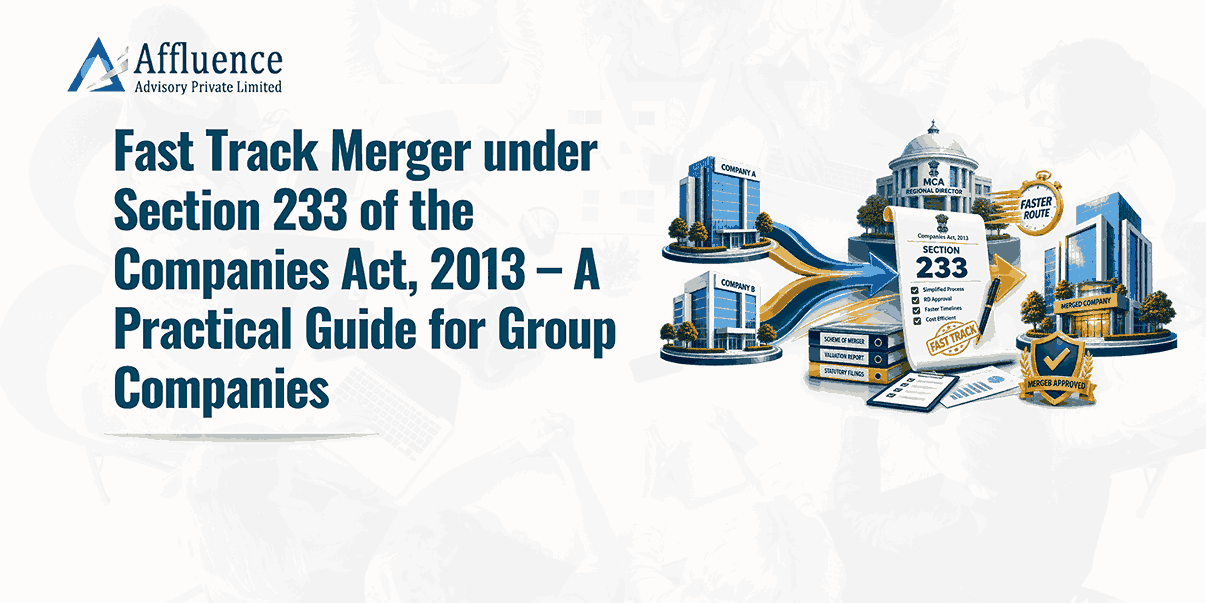
Recognising that not all mergers warrant judicial intervention, the legislature introduced Section 233 under the Companies Act, 2013 to provide a Fast Track Merger mechanism for specified classes of companies. Instead of obtaining approval from the NCLT, eligible companies can complete the merger through the Regional Director (RD), making the process significantly quicker, more economical, and administratively efficient.
Initially, the scope of Section 233 was relatively narrow. It was available only for mergers between:
- Two or more Small Companies;
- A Holding Company and its Wholly Owned Subsidiary;
- Two or more Start-up Companies; and
- One or more Start-up Company with one or more Small Company.
While the introduction of the Fast Track Merger mechanism was a welcome reform, its limited applicability meant that several group companies still had to undertake the conventional NCLT route despite their mergers being purely internal restructurings.
The 2025 Amendment – A Significant Expansion:
In line with the Government’s commitment to improving the ease of doing business, the Ministry of Corporate Affairs (MCA) notified the Companies (Compromises, Arrangements and Amalgamations) Amendment Rules, 2025, effective from 4 September 2025. These amendments considerably widened the scope of Rule 25, enabling a broader range of corporate reorganisations to utilise the fast-track route.
Pursuant to the amendment, the Fast Track Merger mechanism is now available to the following additional classes of companies:
- Two or more small companies;
- Between a holding company and its wholly-owned subsidiary company;
- Two or more start-up companies;
- One or more start-up company with one or more small company;
- One or more unlisted company, (not being Section 8 company) with one or more unlisted company, (not being Section 8 company), where every company involved in the merger-
- has, in aggregate, outstanding loans, debentures or deposits not exceeding 200 crore rupees, and has no default in repayment of loans, debentures or deposits on a day, not more than thirty days before the date of notice of merger referred to in clause (a) of sub-section (1) of section 233 of the Act and on the date of filing of scheme under sub-section (2) of section 233 of the Act.
These amendments represent a major policy shift. Rather than limiting the fast-track route to small companies and wholly owned subsidiaries, the Government has recognised that many internal group restructurings involve minimal public interest and therefore do not require prolonged judicial oversight.
For corporate groups, this change translates into shorter timelines, lower transaction costs, reduced dependence on the NCLT, and greater flexibility in implementing restructuring strategies. It is expected to encourage businesses to simplify complex group structures and improve operational efficiency through a faster and more practical regulatory framework.
Practical Procedure for a Fast Track Merger under Section 233:
Once the companies ascertain that they satisfy the eligibility conditions prescribed under Section 233 of the Companies Act, 2013 read with Rule 25 of the Companies (Compromises, Arrangements and Amalgamations) Rules, 2016, they may initiate the Fast Track Merger process. Although the procedure is considerably simpler than the conventional NCLT route, it requires careful planning, timely statutory filings and coordination with various regulatory authorities.
Step 1 – Preliminary Assessment and Appointment of Professionals:
Before initiating the merger, both the transferor and transferee companies should conduct a preliminary assessment to confirm their eligibility under the Fast Track Merger provisions. Once eligibility is established, the companies should appoint the necessary professionals, including a Registered Valuer for determining the share exchange ratio (where applicable) and the Statutory Auditor for issuing certificates relating to the statement of assets and liabilities, accounting treatment and other certifications required under the Rules.
Step 2 – Approval by the Board of Directors:
The next stage involves convening a Board Meeting of both the transferor and transferee companies. At this meeting, the Board should consider and approve the valuation report, draft Scheme of Merger, draft notice in Form CAA-9, Declaration of Solvency in Form CAA-10, statement of assets and liabilities and the notices convening the meetings of members and creditors. The Board should also authorise designated directors or officers to sign the necessary documents, make statutory filings and complete all acts required for implementation of the Scheme. The Board Resolution approving the Scheme be filed with the Registrar of Companies in e-Form MGT-14.
Step 3 – Filing of the Draft Scheme and Declaration of Solvency:
After the Board’s approval, both companies are required to circulate the draft Scheme of Merger by issuing a notice in Form CAA-9 inviting objections or suggestions from the concerned authorities. The notice is filed with the Registrar of Companies through e-Form GNL-1, while copies are simultaneously served upon the Official Liquidator, the Income Tax Department, and any other sectoral regulator, wherever applicable. In addition, each company is required to file a Declaration of Solvency in Form CAA-10 with the jurisdictional Registrar of Companies through e-Form GNL-2, confirming its ability to discharge its liabilities after the proposed merger.
Step 4 – Consideration of Objections and Suggestions:
Upon receipt of the notice, the Registrar of Companies, Official Liquidator or any other regulatory authority may examine the proposed Scheme and seek additional information, clarifications or supporting documents. Any objections or suggestions are generally communicated within 30 days from the date of filing of Form CAA-9, and the companies are required to respond satisfactorily before proceeding further.
Step 5 – Approval of Members and Creditors:
After the expiry of the notice period, the companies should convene the meetings of their shareholders and creditors for approval of the Scheme. The Scheme must be approved by members holding at least 90% of the total number of shares, while creditors representing nine-tenths in value of the outstanding debt must also approve the proposal. Where creditors representing the prescribed value provide their written consent, the meeting of creditors may be dispensed with. Following the approval of the members, the Special Resolution should be filed with the Registrar of Companies in e-Form MGT-14 within the prescribed timeline.
Step 6 – Filing of the Approved Scheme with the Regional Director:
Within 15 days of the conclusion of the meetings of members or creditors, the transferee company is required to file the approved Scheme together with the report of the meetings in Form CAA-11 before the jurisdictional Regional Director through e-Form RD-1. Simultaneously, copies of the Scheme are filed with the Registrar of Companies through e-Form GNL-1, while copies are also forwarded to the Official Liquidator and the concerned sectoral regulators, if applicable.
Step 7 – Examination by the Regional Director:
The Regional Director examines the Scheme after considering the observations received from the Registrar of Companies, Official Liquidator and other regulatory authorities. If necessary, the Regional Director may seek additional information or documents from the companies before arriving at a decision. In cases where no objections are received, and the Regional Director is satisfied that the Scheme is in accordance with law and not prejudicial to public interest or the interests of stakeholders, the Scheme is confirmed by issuing an order in Form CAA-12. However, where significant objections exist, the matter may be referred to the National Company Law Tribunal for adjudication.
Step 8 – Filing of the Confirmation Order and Completion of the Merger:
Upon receipt of the confirmation order, both the transferor and transferee companies are required to file the order with their respective Registrar of Companies in e-Form INC-28. Where the merger results in an increase in the authorised share capital of the transferee company, the necessary filings and payment of the prescribed filing fees and differential registration fees, if any, should also be completed. Further, the applicable stamp duty on the merger order or scheme, as prescribed under the relevant State Stamp Act, should be duly assessed and paid.
Upon registration of the order and completion of the applicable post-merger compliances, the Scheme becomes effective; the assets, liabilities, rights, obligations, licences and contracts of the transferor company automatically vest in the transferee company, and the transferor company stands dissolved without undergoing the process of winding up.
Conclusion:
The recent expansion of the Fast Track Merger framework has made Section 233 one of the most effective corporate restructuring mechanisms available under the Companies Act, 2013. By extending the benefit to a wider range of unlisted group companies and intra-group mergers, the MCA has significantly reduced the dependence on the NCLT for internal reorganisations.
For business groups seeking to consolidate subsidiaries, eliminate redundant entities, reduce compliance costs, and streamline operations, the Fast Track Merger route offers a faster, cost-effective, and commercially practical alternative to the traditional merger process. When supported by proper documentation and timely compliance with the prescribed forms and timelines, Section 233 can facilitate a seamless restructuring with minimal regulatory intervention, making it an increasingly preferred route for group company reorganisations in India.
Disclaimer: This article provides general information existing at the time of preparation and we take no responsibility to update it with the subsequent changes in the law. The article is intended as a news update and Affluence Advisory neither assumes nor accepts any responsibility for any loss arising to any person acting or refraining from acting as a result of any material contained in this article. It is recommended that professional advice be taken based on specific facts and circumstances. This article does not substitute the need to refer to the original pronouncement.
CLICK HERE TO DOWNLOAD PDF