Ask a promoter how the business is really doing and the answer will contain things no report does. He knows which customer will pay in March rather than January, which supplier can be pushed by a week, and which project is quietly going wrong. None of it is written down. Almost all of it is right.
This is not a weakness. For the first twenty years it is the greatest advantage a family business has: judgment held in one head, applied in a conversation rather than a committee, at no cost and no delay.
The difficulty is that it does not scale, and it cannot be handed on. The strain begins the moment the business grows larger than one person can see. The question stops being how do we grow, and becomes: can the business grow without becoming more dependent on the people who built it? That shift from judgment to systems is the transition from a family enterprise to an institution. It is not a rejection of what made the business successful, but the work of encoding it so the same quality of decision survives scale and time.
Ambition ahead of architecture
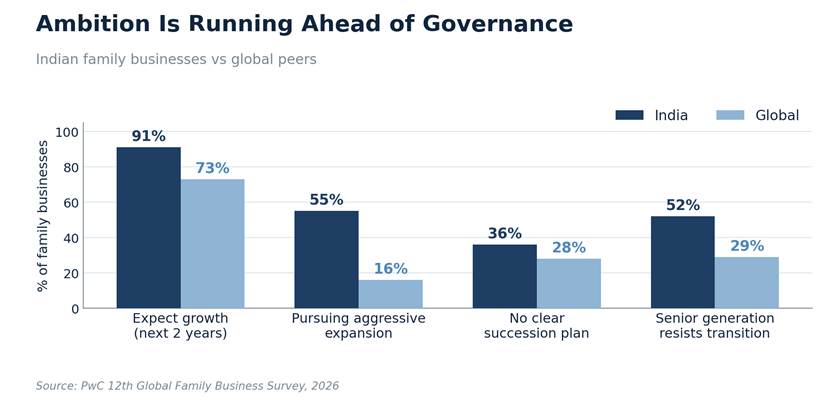
Family-owned businesses generate more than three-quarters of India’s GDP, and they enter the next decade with unusual confidence. PwC’s 12th Global Family Business Survey found that 91% expect to grow over the next two years against 73% globally, and 55% are pursuing aggressive expansion against just 16% of global peers.
Readiness has moved in the opposite direction. 36% have no clear succession plan. 52% report that the senior generation resists transitioning leadership, close to double the global figure. Roughly a third of boards remain family-only.
EXHIBIT 1
Asked what might go wrong, these businesses look inward rather than outward, and they are right to. The binding constraint on the next decade is not the market. It is the architecture.
Growth that consumes cash
Growth is usually celebrated through a single number. Revenue is where the financial story begins, not where it ends.
Consider a company that grows from Rs. 500 crores to Rs. 700 crores over three years. Over the same period receivables climb from Rs. 60 crores to Rs. 130 crores and inventory from Rs. 80 crores to Rs. 150 crores, while the EBITDA margin stays flat and debt rises to fund the difference.
EXHIBIT 2 · THE ECONOMICS OF Rs. 200 CRORES OF GROWTH
| Particulars | Year 1 | Year 3 | Change |
|---|---|---|---|
| Revenue | 500 | 700 | +200 |
| Receivables and inventory | 140 | 280 | +140 |
| EBITDA at a flat 12% margin | 60 | 84 | +24 |
| Interest on the new capital at 10% | – | – | (14) |
| What the growth added | ~10 |
Illustrative. Margin and interest rate assumed for demonstration.
The headline says the business grew by Rs. 200 crores. The balance sheet says something less comfortable. Working capital rose from Rs. 140 crores to Rs. 280 crores: seventy paise of every incremental rupee of revenue was absorbed before it could become cash. At a 12% margin the extra revenue earns roughly Rs. 24 crores a year and permanently consumes Rs. 140 crores of capital. Funded by debt at 10%, Rs. 14 crores of that Rs. 24 crores is claimed by interest before depreciation or tax. The business has worked considerably harder, carried materially more risk, and created very little value.
The promoter is not wrong to feel the company has grown. It has. He is also not wrong to feel there is no more money in the bank than three years ago. There isn’t. The two facts sit in different statements, and in most family businesses only one of those statements is read closely.
The old lens asks how much the company grew. The institutional lens asks how profitably it grew, how much capital it consumed, and what return that capital earned.
One chain, not a checklist
Institutionalisation is not a collection of disconnected initiatives an ERP system, a CFO hire, a board. It is a single chain of visibility running from revenue through gross margin, EBITDA, operating cash flow and capital employed to return on capital. A business can report strong revenue and carry weak margins, strong EBITDA and generate poor cash flow, healthy cash flow and still allocate capital badly. Each link fails independently, and each failure stays invisible if management watches only the link above it.
The chain also must be drawn around the right boundary. Many family enterprises are not one company but four: a manufacturing entity, a trading arm, a property holding, a partnership. Capital, guarantees and margin move between them, and every set of accounts looks reasonable on its own. Only a consolidated view shows what the group earns on the capital the family has committed.
Incentives must then track the chain, not the headline. A sales leader paid on revenue alone will discount to hit the number; one who also carries collections will not. In many family businesses receivables belong to nobody: sales books the order, finance chases the payment, and the promoter intervenes only when a balance grows large enough to be concerning. Institutionalisation means the person who granted the credit carries the consequence of it. The same discipline applies to capital. Every deployment needs an expected return, a named owner and a review after the fact. Few organisations revisit whether an approved investment delivered what it promised, which is precisely how optimistic assumptions get recycled into the next proposal.
Professionalisation is not about removing the family
This is the most misunderstood part of the transition, and the reason it is so often resisted. The goal is not to replace the family with professionals. It is to separate three roles that a founder-led business holds in a single pair of hands.
EXHIBIT 3 · THREE ROLES, ONE PAIR OF HANDS
| Ownership | Management | Governance | |
|---|---|---|---|
| What it decides | Direction, risk appetite, time horizon | How the plan is executed, day to day | Whether the plan and its risks stand up |
| Who should hold it | The family | Whoever is best qualified | People with no stake in the outcome |
| Sign it has collapsed | Every decision waits on one calendar | The chief executive is overruled privately | The board is informed, never challenges |
The three roles can be shared. They cannot be indistinguishable.
The cost of leaving them merged compounds quietly. McKinsey finds the share of bottom performers among Indian family-owned businesses rising from about 33% in the founding generation to 43% in the second and 46% in the third and beyond. The founder’s central advantage is complete context held in one head which is precisely what cannot be inherited. Each generation inherits the assets and the relationships, but not the instinct, and unless systems were built in the interim there is nothing to inherit in their place.
Separating the roles on paper is the easy half. The hard half is whether the organisation reroutes its decisions accordingly. A professional chief executive can be appointed on Monday, and by Friday the plant head is still calling the promoter directly, the bank still wants the promoter in the room, and the new hire has learnt that the authority announced at the town hall was never transferred. Senior professionals rarely leave family businesses over pay. They leave over responsibility without the matching mandate. The test is unglamorous but reliable: when something goes badly wrong, who does the organisation call first?
The cost of waiting
Institutionalisation rarely begins from conviction. It usually begins with an event: a succession, a fundraise, a lender’s covenant, a partner exit, a health scare. The difficulty with external triggers is that they set the timetable. Building a reporting chain during a due diligence process is expensive and visibly reactive; building the same chain three years earlier is ordinary work at ordinary cost.
It also shows up in price. Every buyer, investor and lender eventually asks how much of the performance is separable from the person running it. Where little of it is, the discount arrives quietly in the valuation, in the covenants, in the size of the personal guarantee. Institutionalisation is the difference between a business that can be handed over and one that can only be attended.
The 90-day test
There is a simple way to find out where a business stands today. If the promoter stepped away from operations for 90 days, what would happen? Would management know which customers and products are genuinely profitable? Would a major capital expenditure follow a defined approval process, or wait? Would collections hold their pace? Every item that would stall marks a decision still held in one head and not yet converted into a system. That list, written honestly, is the institutionalisation agenda usually shorter and far more specific. A company does not become an institution because it installs an ERP system or appoints independent directors. Those are instruments, not outcomes. It becomes one when the quality of decision-making stops depending on any single individual.
The family stays at the heart of the enterprise, and should: patient capital, long horizons and cultural continuity are real advantages other ownership structures struggle to replicate. That is exactly why they deserve protection more durable than one person’s presence in the building.
SOURCES
— PwC, 12th Global Family Business Survey — Indian family businesses: The age of reinvention (2026).
— McKinsey & Company, Five differentiators of outperforming family-owned businesses in India.
— The Rs. 500–700 crores example is illustrative; margin and interest rate are assumed for demonstration.
Disclaimer: This article provides general information existing at the time of preparation and we take no responsibility to update it with the subsequent changes in the law. The article is intended as a news update and Affluence Advisory neither assumes nor accepts any responsibility for any loss arising to any person acting or refraining from acting as a result of any material contained in this article. It is recommended that professional advice be taken based on specific facts and circumstances. This article does not substitute the need to refer to the original pronouncement.
CLICK HERE TO DOWNLOAD PDF