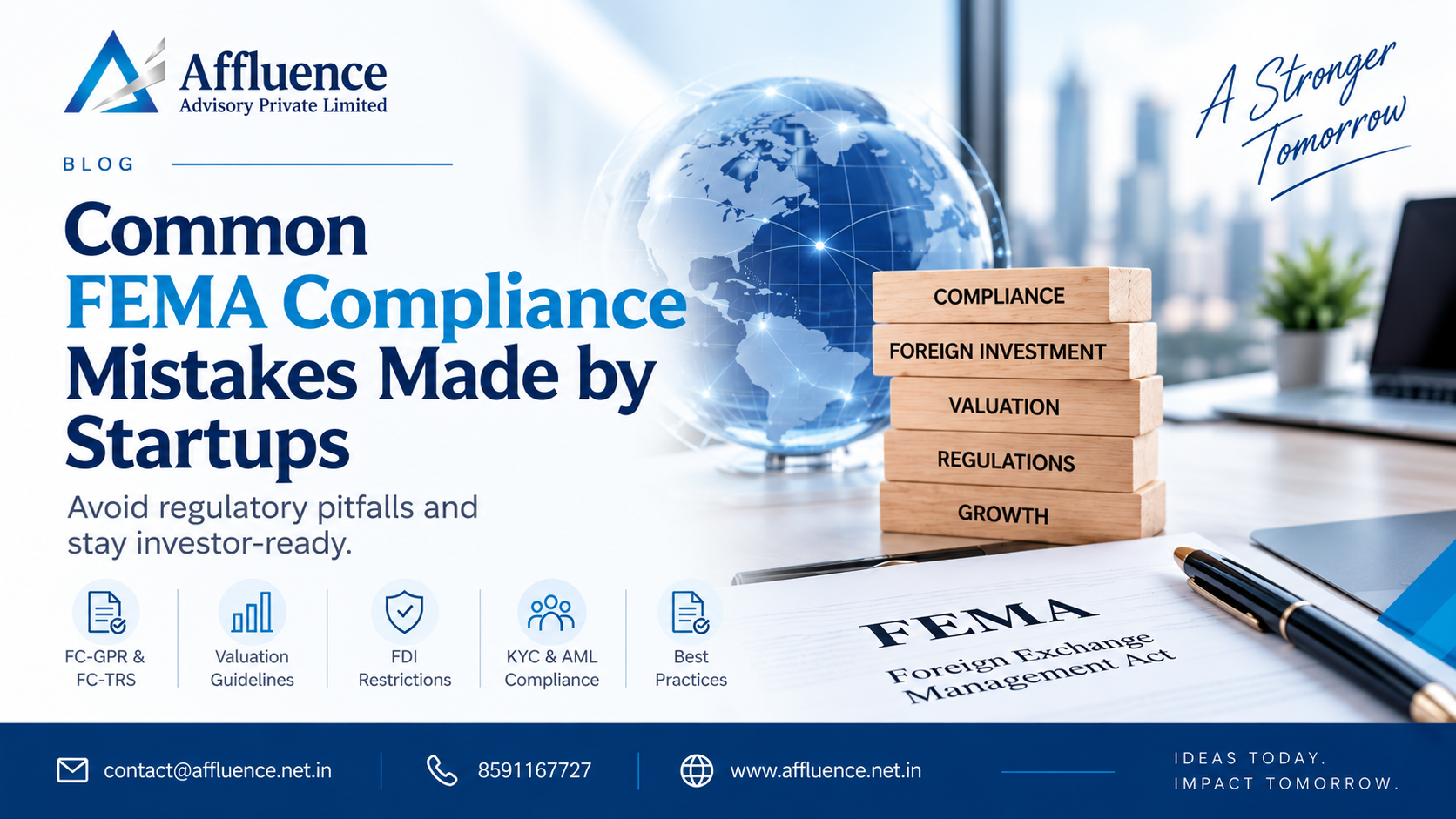
The Foreign Exchange Management Act, 1999 (FEMA) is a regulatory framework governing cross-border financial transactions. For entities operating in the startup segment, receiving foreign investment requires FEMA compliance. Yet, there are many startups that make critical compliance mistakes that result in penalties and regulatory actions by regulatory authorities.
What could be the common FEMA compliance mistakes startups make? Let’s dive deeper into it.
Why FEMA Compliance Matters for Startups
A startup may receive funding from outside India. Such investment can be raised by either issuing Equity Shares, Preference Shares, or any other debt instrument. The onus of FEMA compliance is triggered as soon as the foreign investment hits the Indian Company’s Bank Account.
FEMA 1999 replaced the erstwhile FERA 1973, and major violations were decriminalized from criminal offenses into civil contraventions because India’s economic shift from a closed, restrictive market to an open, liberalised economy required facilitating foreign trade and investment rather than punishing businesses. However, FEMA attracts substantial penalties for non-compliance. Apart from attracting penalties/fines from regulatory authorities, it may also result in,
- Delay in future funding rounds as investors conduct rigorous due diligence on FEMA status.
- Regulatory notices and investigations by the Enforcement Directorate.
- Prevent acquisitions and corporate transactions.
- Restrict remittances, dividend payments, and outbound transfers.
Understanding the Regulatory Framework
The Foreign Exchange Management Act, 1999, replaced India’s earlier restrictive FERA regime with a more liberal approach to foreign exchange. FEMA governs all transactions in foreign currency, foreign securities, including cross-border payments, and capital account transactions.
The Most Common FEMA Compliance Mistakes Made by Startups
Mistake 1: Failing to File FC-GPR Within the 30 Day Timeline
What is FC-GPR?
Form FC-GPR (Foreign Currency Gross Provisional Return) is the foundational FEMA compliance filing. It must be filed with the RBI through an Authorised Dealer (AD) bank within 30 days of allotting shares to a foreign investor.
Why Startups Fail?
Many startup founders are unaware of this requirement or assume their investor’s legal team will handle filing. Some miss the deadline while navigating share certificates, board approvals, and incorporation complexities.
Impact?
Missing this single deadline can trigger hefty penalties, freeze future funding rounds, and severely damage investor confidence.
How to avoid non-compliance?
- Designate a compliance team immediately upon closing a funding round.
- Mark the 30 day timeline before share allotment.
- Coordinate with your Authorised Dealer bank beforehand to file FC-GPR and keep the drafts handy.
- Maintain a compliance checklist with all FEMA filing dates.
Mistake 2: Incorrect Valuation of Shares
FEMA mandates that shares issued to non-resident investors must be valued at fair market value (FMV). This valuation must be certified by a Chartered Accountant (CA) or Merchant Banker (Category I Merchant Banker registered with the Securities and Exchange Board of India (SEBI)).
Common Mistakes:
- Undervaluing shares to reduce tax burden which leads to transfer pricing issues and FEMA violations.
- Overvaluing shares to inflate the round size which raises RBI questions about inflated valuations during compliance check.
- Using self-prepared valuations instead of certified third-party valuations.
- Failing to document valuation methodology clearly.
Consequences:
RBI enforcement action can make the transactions void and impose penalties, and trigger tax scrutiny from income tax authorities.
Prevention Measures:
- Engage a qualified Chartered Accountant or Merchant Banker early in fundraising for conducting timely valuation.
- Use recognized valuation methods.
- Align valuation timings with share allotment dates
Mistake 3: Ignoring Sectoral Caps and FDI Restrictions
What Are Sectoral Caps?
The Consolidated FDI Policy restricts foreign ownership in certain sensitive sectors. For example:
- 100% FDI allowed: Information Technology (IT), Software Services, Engineering Goods
- 74% FDI cap: Insurance sector
- 51% cap: Telecom, Civil Aviation
- 0% (Prohibited): Lottery, Gambling, Atomic Energy (except under certain conditions)
How Startups Go Wrong?
Many startups misclassify their primary business activity or accept investment that exceeds sector-specific caps.
For instance, a fintech startup operating in regulated financial services might be subject to stricter FDI norms than anticipated.
Real-World Impact?
Exceeding sectoral caps can result in the RBI refusing to recognize the investment, freezing the investor’s stake, and demanding equity dilution to comply.
What is the Best Practice?
- Verify your startup’s sector classification using the National Industrial Classification (NIC) code.
- Refer to the latest Consolidated FDI Policy before structuring investment rounds.
- If you operate in multiple sectors, identify the primary sector correctly
- Document any government approvals (if applying the Government Route)
Mistake 4: Failing to File FC-TRS for Share Transfers
When Does FC-TRS Apply?
Form FC-TRS (Foreign Currency Transfer of Shares) must be filed within 60 days of transfer of shares or receipt / remittance of funds whichever is earlier.. This applies to secondary share transfers as well.
Oversight That Costs?
Founders often overlook FC-TRS because they focus on initial funding documentation. However, any subsequent share transfers require separate filings.
How to Stay Compliant:
- Maintain a spreadsheet tracking all non-resident shareholdings.
- Flag any share transfer events.
- File FC-TRS through your Authorised Dealer within 60 days via the FIRMS portal.
Mistake 5: Non-Compliance with KYC and AML Norms
The Requirement?
RBI Master Directions mandate comprehensive KYC and AML checks on all foreign investors. This includes verifying the investor’s identity, source of funds, beneficial ownership, and compiance with international sanctions lists.
Where Startups Stumble?
- Rushing through KYC processes to close funding quickly.
- Not obtaining adequate documentation of source of funds from investors.
- Overlooking beneficial ownership documentation for corporate investors.
What are the Red Flags?
If your KYC is inadequate, the RBI can refuse to process FC-GPR, your Authorised Dealer bank can reject the remittance, and you face regulatory action.
Compliance Checklist:
- Obtain certified copies of investor passport/government ID’s.
- Collect comprehensive details on beneficial owners and source of funds.
- Document proof of investment source.
- Maintain KYC records of the investor.
Conclusion: Building a FEMA-Compliant Startup
FEMA compliance is not a one-time box to check. It is an ongoing obligation that starts the moment foreign funds enter your startup and continues for the life of the investment.
Conversely, startups that build compliance into their DNA from day one gain significant competitive advantages:
- Seamless fundraising
- Smooth M&A exits
- Operational flexibility
- Founder peace of mind
Disclaimer: This article provides general information existing at the time of preparation and we take no responsibility to update it with the subsequent changes in the law. The article is intended as a news update and Affluence Advisory neither assumes nor accepts any responsibility for any loss arising to any person acting or refraining from acting as a result of any material contained in this article. It is recommended that professional advice be taken based on specific facts and circumstances. This article does not substitute the need to refer to the original pronouncement.
CLICK HERE DOWNLOAD PDF