In its first decade the Insolvency and Bankruptcy Code returned about Rs. 4.32 lakh crore to creditors against admitted claims of nearly Rs. 14 lakh crore. Read as a recovery rate, that is a loss of roughly 69 paise in the rupee. Read against what those businesses were worth on the day they were admitted, the same amount is about 95% of everything left. Both figures are correct, and the distance between them is the subject of this article.
The headline number in any case is the haircut. A creditor is owed Rs. 1,000 crores, a resolution plan offers Rs. 300 crores, and the conclusion appears immediate: a 70% haircut, Rs. 700 crores lost. Insolvency economics is not that simple.
A claim is a contractual entitlement, not a measure of the economic value behind it. The amount owed keeps growing even as the business supporting it deteriorates, so by the time a company enters the Corporate Insolvency Resolution Process (CIRP) it may be worth a fraction of the liabilities accumulated against it.
A large haircut may reflect value destruction, or it may be the market price of resolving a business whose economic value had fallen below its liabilities long before a tribunal was approached. The first is a failure of value preservation; the second, an arithmetic consequence of distress. Distinguishing them means asking how much value existed, how much had gone, and how much the process preserved.

The claim grows while the business shrinks
Haircut = 1 – (Realisation ÷ Admitted claims).
As a measure of creditor recovery this is necessary. As a measure of value destruction it quietly misleads. Admitted claims comprise principal, contractual and penal interest and other permissible liabilities. None establishes the current economic value of the enterprise, and the two move in opposite directions during distress: interest accrues on debt no longer being serviced, so the claim compounds upward through exactly the period in which cash flows, margins, customer relationships and asset values are deteriorating. The denominator inflates while the business behind it shrinks.
Those two readings come from the same decade of data. Realisation of about Rs. 4.32 lakh crore is close to 31% of admitted claims and a haircut near 69%, but it is also about 95% of estimated fair value and 167% of liquidation value.
Illustration 1
Where does Rs. 100 of admitted claim actually go?
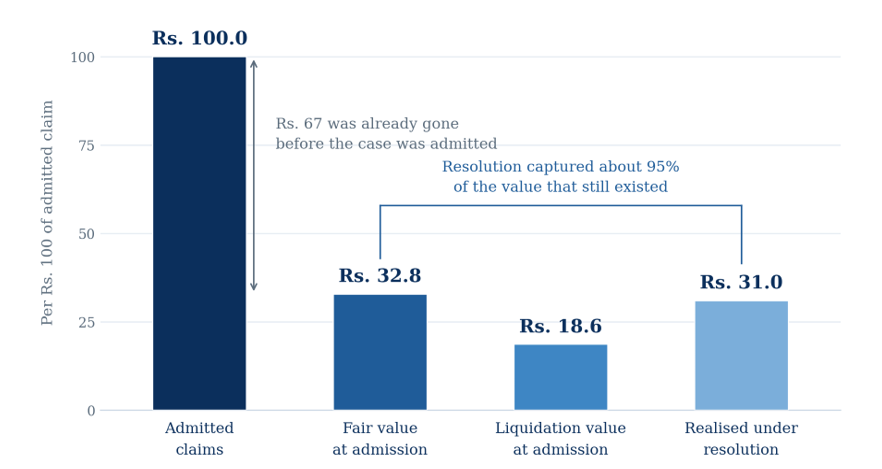
IBBI and Ministry of Corporate Affairs data as on 31 March 2026. Values per Rs. 100 of claim are implied from the reported ratios; illustrative of scale
Those ratios resolve onto a single scale. They imply that every Rs. 100 of admitted claim was backed by roughly Rs. 33 of going-concern value and about Rs. 19 of liquidation value on the day of admission. Two-thirds of the claim had no economic substance behind it before the process began; resolution returned close to Rs. 31.
Process
On admission, control passes from the board to a resolution professional, supervised by a committee of creditors (CoC). Registered valuers estimate fair value (the going concern) and liquidation value (the assets sold piecemeal). Applicants bid, the CoC votes and the tribunal approves. If no plan is approved in time, the company is liquidated and proceeds distributed in the order set by Section 53; dissenting financial creditors must receive at least liquidation value.
Value destruction begins before insolvency
CIRP is the consequence of distress, not its origin, and distress is self-reinforcing: weak performance reduces cash generation, raises dependence on costly funding, strains suppliers and employees, and weakens revenues further. By the time a case is admitted, much of the loss is embedded.
That produces two sources of loss, which the haircut collapses into one. Pre-CIRP destruction is value lost before entry: a credit and governance failure, sunk by the date of admission. In-process destruction is value lost after commencement, because the business was not preserved. Only the second can be laid at the system’s door.
The caseload shows how much sits in the first category: about 40% of CIRPs have involved companies already defunct when admitted, where creditors realised roughly 19% of admitted claims against about 32% overall.
Not all of that loss is ordinary decline. By June 2026, resolution professionals had filed 2,132 applications to reverse preferential, undervalued, extortionate or fraudulent transactions involving about Rs. 4.65 lakh crore. Claw-backs ordered have been a small fraction of that and come long after the plan is approved: value taken out of a company before admission is rarely restored by the process that follows.
What resolution is buying
Three concepts must be held apart: fair value, the debtor as a going concern; liquidation value, what dismantling and selling the assets would realise; and resolution value, what an applicant will pay. A going concern commands a premium because its value lies in customers, employees, licences and market position as much as in assets. Recovery against liquidation value is therefore often more informative than recovery against claims, and Section 30(2)(b) makes it the floor for dissenting financial creditors.
The benchmarks were long the weak link. In February 2026 the IBBI amended the CIRP Regulations to appoint two sets of valuers under a coordinating valuer, to set fair value as the average of the two closest estimates, and to require a third set where estimates diverge by 25% or more. Fair value was also redefined to capture the debtor as a whole, including intangibles and synergies. That such a threshold was needed shows how wide the spread had been, and the wider definition raises the bar every plan is judged against.
A distressed business is not a static asset awaiting sale. Losses continue, working capital tightens, customers migrate to competitors who can promise continuity, and skilled employees leave first. Bidders discount for lengthening uncertainty and for the condition in which they expect to receive the business. Delay does not postpone recovery; it changes the asset being sold, and with it the price.
The data is uncomfortable. The average time to conclude a CIRP through a resolution plan reached 744 days by March 2026, up from 713 a year earlier and close to three times the period the Code contemplates; 78% of ongoing cases had already crossed 270 days. Speed is not an administrative preference. It is a valuation input.
A haircut must be judged against the counterfactual
The relevant question is not whether creditors recovered less than they were owed, since full recovery usually ceased to be possible long before the file reached the tribunal, but what the best achievable outcome was.
Illustration 2
Four ways out of distress, and what each one returns
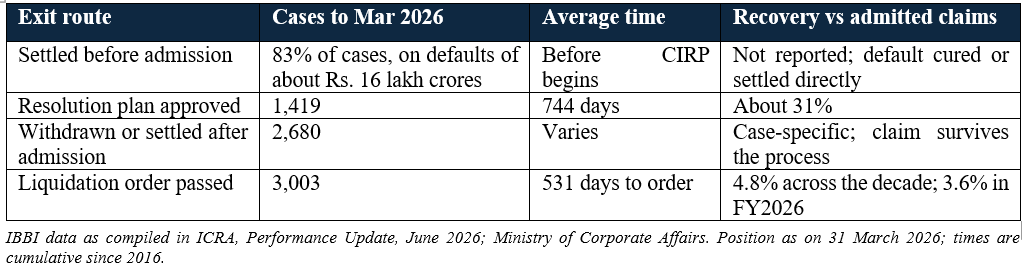
The realistic alternative to a resolution plan is not full repayment. It is liquidation, which has returned under 5% of admitted claims across the decade and 3.6% in the most recent year, so a 69% haircut is close to the best outcome still available once a case is admitted. The same holds across channels: of the Rs. 1.04 lakh crore recovered by banks in 2024-25, the IBC accounted for 52.4%, more than SARFAESI, the debt recovery tribunals and Lok Adalats combined.
The more striking row is the first. Roughly five in six debtors taken to the tribunal never reach admission, settling once proceedings are threatened. That is where the Code has done most of its work, and it is the only row in which value is preserved rather than divided.
An average across 1,419 cases hides very different assets. Large accounts, with admitted claims above Rs. 1,000 crore, are about 11% of resolved cases but close to 89% of the value recovered. The rest is small, often defunct debtors: negligible in rupee terms, heavy in the average.
Two consequences follow. A single national haircut figure is an unreliable measure of performance; outcomes should be read by segment. And capacity should follow value: resolving large operating businesses faster returns far more than chasing dormant shells, where quicker liquidation preserves more than slow attempted revival.
What the haircut stops counting
The haircut stops counting on the day the plan is approved. It measures recovery against a past claim, not what the rescued business produces afterwards, though that is the purpose of preferring resolution to liquidation. Work by IIM Ahmedabad on resolved firms found sales up 76%, capital expenditure up 130% and break-even by the third year, with the market value of listed resolved firms tripling to about Rs. 6 lakh crore.
The 2026 Reforms
The legislative response amounts to an official diagnosis. The Insolvency and Bankruptcy Code (Amendment) Act, 2026 creates a creditor-initiated process under a new Chapter IV-A: notified financial creditors holding at least 51% in value may commence resolution out of court, with the board in possession under a resolution professional, on a 150-day clock. Alongside it sit mandatory admission timelines, a three-month limit on NCLAT appeals, group and cross-border frameworks, and penalties for frivolous applications.
Almost every substantive change targets time and control: how quickly a case begins, how long it runs, and who decides. More telling still, the amended CIRP Regulations now require the committee of creditors to record its reasoning on what a plan recovers against fair value and liquidation value, and on the rigour of the price discovery behind it. The framework set out here is no longer an analytical preference; it is a documentation requirement.
What this means for stakeholders
For lenders. The decisive determinant of recovery is the date of recognition, not the conduct of the process. Recovery is an early-warning discipline: the triggers that matter are operational, such as stretched creditor days, promoter pledges and slipping capex, not the first missed payment.
For boards and promoters. Delay is not a neutral option. Every quarter of deferred recognition compounds the claim and depletes the asset, and the creditor-initiated route removes the assumption that the timing is the debtor’s to choose.
For resolution applicants. The pricing question is not what the company owes, but what can still be preserved and what preservation will cost. Time in process, restoring working capital and the risk of losing key contracts and people belong in the bid.
For committees of creditors. Reasoning must now be recorded against fair value, liquidation value and the quality of price discovery. A plan approved without a documented comparison against the realistic alternatives is exposed, commercially and on appeal.
The real economics of a haircut
Return to the case we began with. A Rs. 700 crore haircut on a Rs. 1,000 crore claim tells you nothing until you know what the enterprise was worth on the day of admission. If fair value stood at Rs. 320 crores, a Rs. 300 crore plan preserved almost everything left. If it stood at Rs. 800 crores, Rs. 500 crore was destroyed on the process’s watch. Same percentage; opposite verdict.
The purpose of the Code is not to eliminate haircuts, and a large haircut cannot by itself establish that the system has failed. The test is whether the process minimises avoidable value destruction, maximises what can realistically be recovered, and leaves a business worth more than the one that went in.
Success in insolvency should not be measured only by how much of the past claim was recovered, but by how much of the remaining economic value was saved.
CLICK HERE TO DOWNLOAD PDF
Disclaimer: This article provides general information existing at the time of preparation and we take no responsibility to update it with the subsequent changes in the law. The article is intended as a news update and Affluence Advisory neither assumes nor accepts any responsibility for any loss arising to any person acting or refraining from acting as a result of any material contained in this article. It is recommended that professional advice be taken based on specific facts and circumstances. This article does not substitute the need to refer to the original pronouncement.